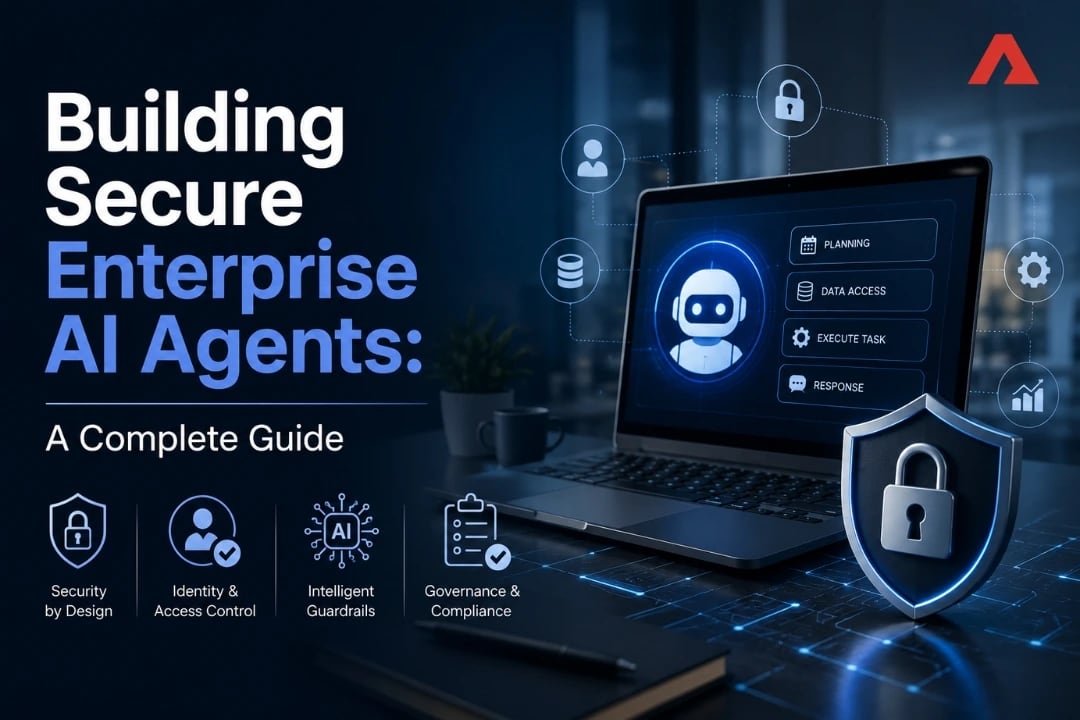
AI agents have moved from experimental pilots to production systems that book meetings, query databases, process refunds, and make decisions without a human clicking "approve" at every step. That autonomy is exactly why enterprise AI agent security has become a boardroom topic instead of a backend concern.
The numbers explain the urgency. A 2026 industry survey found that 88% of organizations have already experienced a confirmed or suspected AI agent security incident, and the average AI agent-related breach now costs roughly $4.7 million (Gravitee, 2026). Meanwhile, Gartner projects that 40% of enterprise applications will feature task-specific AI agents by the end of 2026, up from less than 5% in 2025 (Gartner, 2025).
In short: adoption is outrunning governance.
This guide breaks down what makes AI agents different from traditional software from a security standpoint, the specific risks enterprises are facing in 2026, and the architecture, frameworks, and practices needed to deploy agents that are powerful without becoming a liability.
What Are Enterprise AI Agents, and Why Does Security Work Differently Here?
An enterprise AI agent is a software system built on a large language model that can plan a task, choose tools, take actions across systems, and adjust its approach based on results, largely without step-by-step human instructions. That's the key difference from a chatbot or a traditional automation script: an agent doesn't just respond, it acts.
A customer service chatbot answers questions. A customer service agent can look up an order, issue a refund, update a CRM record, and escalate to a human, all in one session, using its own judgment about which tool to call and when.
This shift from "respond" to "act" is what changes the security conversation. A misconfigured chatbot gives a wrong answer. A misconfigured agent with database write access, payment API credentials, or email-sending permissions can cause real operational and financial damage in seconds.
Organizations exploring this space often start with agentic AI development before realizing that the harder problem isn't building the agent's reasoning loop. It's controlling what the agent is allowed to do once it's reasoning on its own.
The State of AI Agent Adoption in 2026
Before discussing risk, it helps to understand the scale of deployment enterprises are actually dealing with right now.
| Metric | Figure | Source |
|---|---|---|
| Enterprise apps with task-specific AI agents by end of 2026 | 40% (up from <5% in 2025) | Gartner |
| Organizations scaling agentic AI in at least one function | 23% | McKinsey |
| Organizations still experimenting | 39% | McKinsey |
| Organizations reporting confirmed/suspected AI agent security incidents | 88% | Gravitee, 2026 |
| Agentic AI projects expected to be canceled by end of 2027 | 40%+ | Gartner |
| Organizations with full visibility into agent-to-agent communication | 24.40% | Gravitee, 2026 |
Key takeaway: Adoption is accelerating faster than governance maturity. Gartner attributes the high project cancellation rate directly to escalating costs, unclear ROI, and inadequate risk controls, not to the underlying technology failing to work. The agents work. The controls around them often don't.
Why Securing AI Agents Is Different From Securing Traditional Software
Traditional application security assumes a relatively fixed set of inputs, a defined code path, and predictable outputs. AI agents break all three assumptions.
| Dimension | Traditional Software | AI Agents |
|---|---|---|
| Behavior | Deterministic, follows fixed logic | Probabilistic, decisions vary by context |
| Inputs | Structured (forms, APIs) | Unstructured natural language, including from untrusted sources |
| Identity | One service account per app | Often dozens of dynamically spawned agent identities |
| Permissions | Static roles, reviewed periodically | Permissions invoked dynamically at runtime |
| Attack Surface | Code vulnerabilities | Code vulnerabilities + prompt manipulation + tool misuse |
| Oversight | Logs reviewed after the fact | Needs real-time guardrails before action execution |
This is also why identity has become the center of the conversation. Enterprises are now managing machine identities, including AI agents, tools, and orchestration pipelines, at a ratio of roughly 82 machine identities for every 1 human identity, and only 18% of organizations are confident their current identity and access management systems can handle that scale.
The Biggest Security Risks Facing Enterprise AI Agents
In December 2025, OWASP published the first globally peer-reviewed security framework built specifically for autonomous systems: the OWASP Top 10 for Agentic Applications 2026. It's the closest thing the industry has to a standard risk taxonomy for this category.
| Risk | What It Means in Practice |
|---|---|
| Agent Goal Hijacking | An attacker manipulates the agent's objective through crafted input, redirecting it toward an unintended goal. |
| Tool Misuse and Unintended Execution | The agent calls a legitimate tool (email, database, payment API) in a way that causes harm, even without malicious code. |
| Identity and Privilege Abuse | Agents operating with excessive or shared credentials, making actions impossible to trace to an individual or root cause. |
| Missing or Weak Guardrails | No checkpoints exist between the agent's decision and the action it executes. |
| Sensitive Data Disclosure | The agent surfaces confidential data (PII, financials, internal documents) in a response or to an unauthorized system. |
| Data Poisoning | Manipulated training or retrieval data skews the agent's decisions over time. |
| Resource Exhaustion | An agent enters a loop or chains excessive tool calls, driving up cost or denying service to others. |
| Supply Chain Vulnerabilities | Compromised third-party models, plugins, or agent frameworks introduce risk before deployment even begins. |
| Advanced Prompt Injection | Malicious instructions hidden in documents, emails, or web content the agent reads are executed as if they were legitimate commands. |
| Over-Reliance on Autonomous Decision-Making | No human checkpoint exists for high-stakes or irreversible actions. |
Two findings from current research make these risks concrete rather than theoretical:
- 45.6% of enterprises use shared credentials for agent-to-agent authentication, which means there's no individual accountability when something goes wrong.
- More than half of deployed agents run without any security oversight or logging, and only 14.4% of organizations send agents to production with full security or IT sign-off.
The Business Cost of Getting AI Agent Security Wrong
Security failures in AI agents don't stay contained to IT. They show up as:
- Direct financial loss. The average AI agent-related breach costs around $4.7 million, and incidents involving unsanctioned "shadow AI" agents cost an additional $670,000 on average compared to standard incidents.
- Project abandonment. Gartner predicts over 40% of agentic AI projects will be canceled by the end of 2027 due to cost overruns and inadequate risk controls, not because the use case was wrong.
- Regulatory exposure. Agents that touch personal data, financial transactions, or healthcare records inherit the compliance obligations of those domains, and a security gap becomes a compliance violation.
- Erosion of trust. McKinsey's research notes that 51% of firms have already reported AI-related incidents, and the organizations that recover fastest are those with governance built in from the start, not bolted on afterward.
Key Takeaway: Security isn't a tax on AI agent projects. It's the difference between a project that scales and one that gets quietly shut down after an incident.
Core Pillars of a Secure Enterprise AI Agent Architecture
1. Identity and Access Management for Agents
Every agent needs a distinct, traceable identity, not a shared service account. NIST's emerging guidance frames this clearly: AI agents should be treated as machine-scale identities with a "digital birth certificate" that includes a documented owner, a defined lifecycle, and enforced IAM controls.
In practice, this means:
- One credential per agent instance, never shared across agents or environments
- Scoped, least-privilege permissions tied to the agent's specific task
- Time-bound or session-bound access tokens rather than standing credentials
- A retirement process for agents that are no longer in active use
2. Guardrails and Human-in-the-Loop Controls
Guardrails are the checkpoints between an agent deciding to act and the action actually executing. For high-stakes operations (financial transactions, data deletion, external communications), a human approval step should sit in that path. For lower-risk, high-volume tasks, automated policy checks can replace a human reviewer, but the check itself should never be optional.
3. Data Governance and Sensitive Data Protection
Agents often pull from multiple data sources to complete a task, which means data classification has to happen before the agent touches the data, not after. Enterprises building this layer typically work with data analytics and data science consulting teams to define what data an agent can access, mask, or never see at all.
4. Monitoring, Logging, and Observability
Every agent action, every tool call, and every decision path should be logged in a way that's queryable after the fact. Given that more than half of agents currently run without oversight, this is the single highest-leverage fix most enterprises can make. Observability for agents typically gets built alongside broader DevOps practices, since the same pipelines that monitor deployments need to extend to monitor agent behavior in production.
5. Secure Tool and API Integration
Agents should call tools through a controlled, sandboxed layer, not direct, unrestricted API access. This limits the blast radius if an agent is manipulated into misusing a tool, and it gives security teams a single point to enforce policy. This is usually built as part of enterprise app development work, where the agent layer sits behind the same access controls as any other enterprise system.
6. Supply Chain and Model Security
Third-party models, plugins, and pre-built agent frameworks should go through the same vetting as any other vendor software: known provenance, patch history, and a clear update path. This is increasingly relevant for teams building on top of generative AI and machine learning foundations, where the underlying model is rarely built fully in-house.
Aligning With Global Frameworks: OWASP, NIST, and Zero Trust
Enterprises don't need to invent agent security from scratch. Three frameworks are converging into something close to an industry standard:
- OWASP Top 10 for Agentic Applications 2026: The risk taxonomy referenced earlier in this guide, plus an Enterprise Adoption Maturity Model introduced at the OWASP GenAI Security Summit in June 2026, which gives organizations a staged path from ad hoc agent use to fully governed deployment.
- NIST AI Risk Management Framework: NIST's Center for AI Standards and Innovation (CAISI) launched an AI Agent Standards Initiative in February 2026, with an AI Agent Interoperability Profile planned for release in Q4 2026, covering identity, authorization, security, and monitoring.
- Zero Trust principles applied to agents: "Never trust, always verify" extends naturally to agents: verify identity on every action, grant the minimum permission needed, and assume any input (including data the agent retrieves on its own) could be adversarial.
Mapping an internal AI agent program against these frameworks early gives enterprises a defensible position for audits, board reporting, and customer due diligence, well before regulation makes it mandatory.
Best Practices Checklist for Building Secure AI Agents
- Assign every agent a unique, traceable identity before it goes live.
- Apply least-privilege scoping to every tool and API the agent can call.
- Require human approval for irreversible or high-value actions.
- Log every decision and action in a centrally queryable system.
- Classify and mask sensitive data before agents are granted access.
- Run agents in sandboxed environments separate from production-critical systems during testing.
- Vet third-party models and agent frameworks for provenance and patch history.
- Test for prompt injection using adversarial inputs before deployment, not after an incident.
- Set rate limits and circuit breakers to prevent runaway resource usage.
- Review and retire unused agent identities on a fixed schedule, not indefinitely.
Common Mistakes Enterprises Make When Deploying AI Agents
- Treating agents like chatbots. A chatbot that gives a bad answer is embarrassing. An agent with the same flaw and write access to a system is a liability.
- Reusing credentials across agents. This is the single most common gap, present in 45.6% of enterprises, and it eliminates any ability to trace an incident back to its source.
- Skipping IT and security review before production. Only 14.4% of organizations currently get full sign-off before launch, which means most agents reach production with unreviewed risk.
- Assuming existing application security covers agents. Static code review and traditional pen testing don't catch prompt injection or goal hijacking, both of which require agent-specific testing approaches.
- No retirement plan. Agents created for a one-off project often keep their credentials and access long after the project ends.
Choosing the Right Technology Partner for Secure AI Agent Development
Given how fast this space is moving, and how thin the in-house expertise still is at most companies (only 18% are confident in their current IAM setup for agents), many enterprises are choosing to build their first secure agent deployments with an experienced partner rather than solely in-house.
When evaluating a partner, look for:
- Track record across the full stack, from custom software development to AI-specific delivery, not just prompt engineering.
- Security built into the development lifecycle, not added as a final review step.
- Experience with the underlying infrastructure, including cloud computing environments where most agents are deployed and sandboxed.
- Demonstrated production deployments, not just proofs of concept. Atharva's Pulsee AI case study is one example of an AI system built and governed for real-world use rather than a demo environment.
Atharva System has spent over a decade building production software for global clients, and our agentic AI practice applies that same engineering discipline, identity controls, guardrails, and observability from day one, to agent deployments rather than treating security as an afterthought.
What's Next for Enterprise AI Agent Security Beyond 2026
A few developments worth watching over the next 12 to 18 months:
- NIST's AI Agent Interoperability Profile, expected in Q4 2026, will likely become a reference point for procurement and vendor evaluation, similar to how earlier NIST frameworks shaped cloud security requirements.
- OWASP's Enterprise Adoption Maturity Model will give organizations a way to benchmark their agent governance against peers, which should help close the gap between executive confidence and actual security posture.
- Identity vendors are racing to support machine-scale identity management, since the current 82:1 ratio of machine to human identities is only going to grow as agent adoption climbs toward Gartner's projected 40% of enterprise apps.
- Insurance and compliance requirements will likely catch up, meaning the documentation and logging practices enterprises build now will matter for audits later, not just for day-to-day operations.
The enterprises that treat governance as infrastructure, built before it's needed rather than after an incident, are the ones McKinsey's research shows scaling AI most successfully.
Conclusion
Enterprise AI agents are no longer a future consideration. They're being deployed now, at scale, often faster than the security controls around them are maturing. The data is clear: most incidents aren't caused by the AI failing to perform its task. They're caused by missing identity controls, absent guardrails, and a lack of oversight during deployment.
The path forward isn't to slow down adoption. It's to build agents with identity, guardrails, monitoring, and data governance designed in from the start, aligned to frameworks like OWASP's Top 10 for Agentic Applications and NIST's emerging AI agent standards.
If your organization is planning or already running AI agent initiatives and wants a security-first approach to development, Atharva System's agentic AI and enterprise app development teams can help you build agents that scale safely. Get in touch to discuss your specific use case.
FAQs
1. What makes AI agent security different from regular application security?
AI agents take autonomous actions across systems based on probabilistic reasoning rather than fixed code paths. Traditional security reviews code logic and access controls, but agents also need protection against prompt injection, goal hijacking, and tool misuse, risks that don't exist in deterministic software because the agent's "decision" happens at runtime, not at build time.
2. What is the OWASP Top 10 for Agentic Applications?
It's a globally peer-reviewed risk framework published by OWASP in December 2025, covering the ten most critical security risks specific to autonomous AI systems, including goal hijacking, tool misuse, identity abuse, and supply chain vulnerabilities. It gives enterprises a standardized checklist for evaluating agent security before deployment.
3. Why is identity management such a big challenge for AI agents?
Each agent, tool, and orchestration pipeline needs its own machine identity, and enterprises are now managing roughly 82 machine identities for every human identity. Most identity and access management systems were built for a world of relatively few service accounts, not this scale, which is why only 18% of organizations feel confident their current systems can handle it.
4. What is prompt injection, and how does it affect AI agents?
Prompt injection happens when malicious instructions are hidden inside content an agent processes, like a document, email, or webpage, causing the agent to follow those hidden instructions as if they came from a legitimate user. It's one of the top risks in the OWASP framework because agents that read external content are especially exposed.
5. How much does an AI agent security breach typically cost?
Current industry data puts the average cost of an AI agent-related breach at around $4.7 million, with breaches involving unsanctioned "shadow AI" agents costing an additional $670,000 on average. Costs include direct financial loss, incident response, and regulatory exposure depending on the data involved.
6. How do I know if my organization's current AI agents are secure?
Start by checking three things: does every agent have a unique, traceable identity rather than a shared credential; is every agent action logged somewhere your team can actually query; and has security or IT formally reviewed the agent before it went into production. If the answer to any of these is no, that's the highest-priority gap to close first.