The app distribution world looks very different today than it did just two years ago. Two platforms once controlled everything: Google Play and the Apple App Store. That grip has loosened considerably.
Regulatory changes in Europe, rapid device growth in Asia, and a growing community of privacy-focused users have created a healthy ecosystem of alternative app stores. In 2026, these platforms are not fallback options. For many developers and businesses, they are primary distribution channels.
According to recent Statista tracking data, Google Play remains the world's largest app marketplace with well over 2 million apps available, while the Apple App Store continues to host more than 1.5 million apps globally. However, raw app counts only tell part of the story. In China, Google Play is blocked entirely. In India and Southeast Asia, Xiaomi and Huawei devices ship with their own stores already installed. In Europe, the regulatory door to iOS alternatives is now wide open.
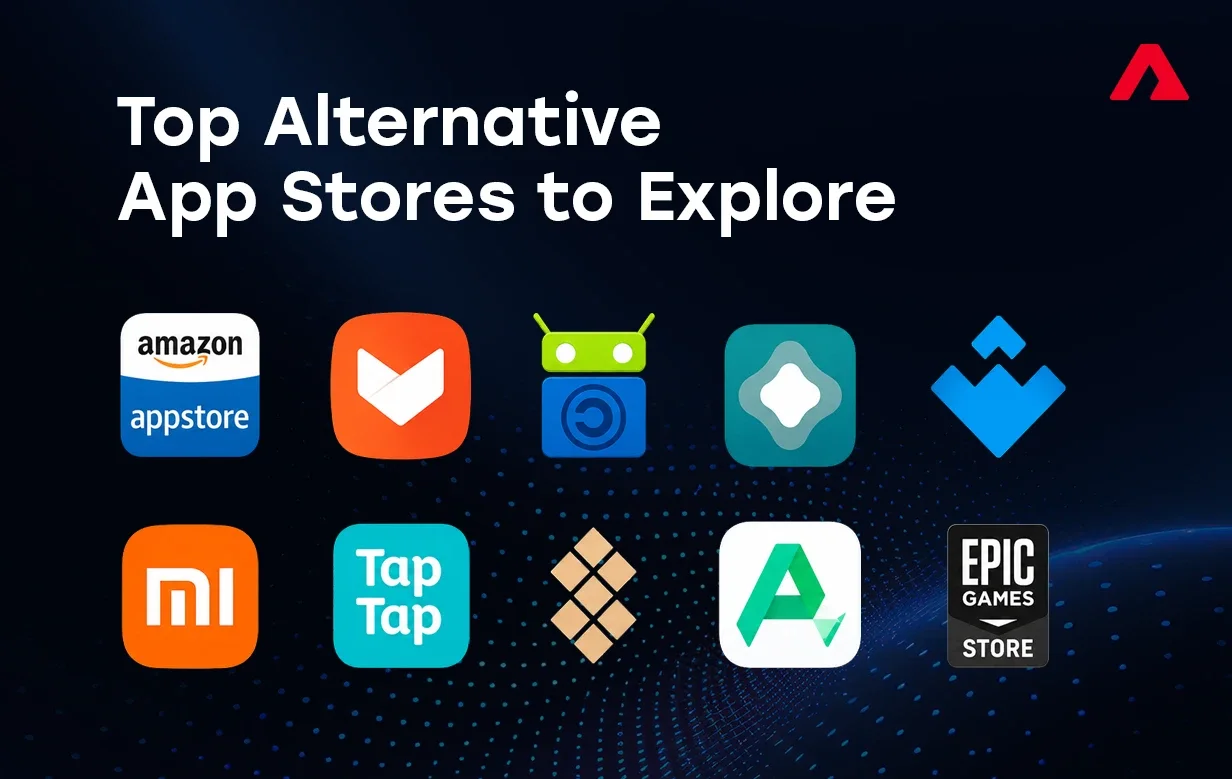
This guide covers 15 of the most relevant alternative app stores in 2026, with up-to-date information, verified data, and a clear explanation of who should use each platform.
Why Alternative App Stores Matter in 2026
Lower Fees
Google Play and the Apple App Store charge up to 30% on in-app purchases and subscriptions. Many alternative stores charge between 10% and 20%, and some charge nothing at all. For startups and independent developers, this difference directly affects how profitable your app can be from day one.
Faster Approvals
Alternative stores often process apps in one to two days. Google Play typically takes three to seven days for a standard review. When you need to push a critical bug fix or a time-sensitive update, faster approvals make a real difference.
Access to Underserved Markets
Mainstream stores have limited reach in China, parts of Southeast Asia, and emerging markets in Africa and Latin America. Alternative stores built specifically for these regions give you direct access to users who may never see your app on Google Play.
Less Competition
With over 2.2 million apps on Google Play, standing out without a paid campaign is extremely hard. On smaller, specialized stores, your app has a much better chance of appearing in top charts, featured lists, and editorial sections organically.
More Flexible Monetization
Some stores support carrier billing, local payment gateways, and alternative payment systems. This is especially useful in markets where credit card penetration is low, such as Southeast Asia, South Asia, and parts of Africa.
The Impact of the Digital Markets Act in 2026
The EU's Digital Markets Act (DMA) came into force in March 2024 and has reshaped app distribution across Europe into 2026. Under the DMA, Apple is legally required to allow third-party app stores on iOS within EU member states. The act also permits sideloading, meaning users can install apps directly from developers without going through Apple's official store.
The practical results have been significant:
- Several new iOS app marketplaces launched and established meaningful user bases in Europe during 2024 and 2025
- Apple's standard 30% commission now faces direct competition from alternative stores charging as little as 12%
- Independent developers can now reach iOS users in Europe without meeting Apple's full review criteria
- Consumer choice has expanded significantly for iPhone users across all EU countries
Similar regulatory discussions are underway in the United States, South Korea, Japan, and India. Industry observers expect global app distribution rules to loosen further by 2027.
Android Alternative App Stores
1. Amazon Appstore
The Amazon Appstore launched in March 2011 and remains one of the most credible alternatives to Google Play. It comes pre-installed on all Amazon Fire tablets and Fire TV devices, and since 2021 it has also been available on Windows 11, which expanded its reach beyond mobile significantly.
According to Statista's Amazon Appstore app count data, the store hosted over 534,000 apps as of Q3 2024. While that number is smaller than Google Play, the catalog is curated and covers the categories users care about most.
Key details for developers:
- No upfront listing fee; Amazon takes a revenue share on paid apps and in-app purchases
- Amazon Coins rewards users for purchases, which increases spending and benefits developers
- Available in more than 200 countries with dedicated regional support
- Developer console includes A/B testing tools, analytics dashboards, and promotional tools
- Historically, Amazon Appstore also expanded onto Windows 11 through Microsoft's Android subsystem initiative, though Microsoft has since begun phasing out Windows Subsystem for Android (WSA) support.
The Amazon Appstore is a strong channel for family apps, games, and productivity utilities. Its user base tends to have higher purchasing intent compared to average Google Play users in the same categories.
How to Install Amazon Appstore on Android
- On your Android phone, open "Settings > Apps > Special app access > Install unknown apps", and allow your browser to install apps.
- Go to "amazon.com/getappstore" and download the Amazon Appstore APK.
- Open the downloaded file from your notifications or Downloads folder and tap "Install".
- Once installed, open the app and sign in with your existing Amazon account.
- Browse the store or search for the app you want and tap "Get" or "Buy".
Fire tablet and Fire TV users don't need to do any of this; Amazon Appstore comes pre-installed.
2. Samsung Galaxy Store
Samsung holds approximately 18.8% of global smartphone market share, according to IDC's Q3 2025 smartphone tracker. Every one of those devices comes with Galaxy Store pre-installed. That automatic access to hundreds of millions of users without any acquisition spend is a distinct advantage for developers.
Rebranded from Samsung Apps in 2018, Galaxy Store has expanded well beyond standard apps. It now includes dedicated sections for Galaxy Watch apps, One UI themes, game optimizations, and Samsung DeX support for desktop mode use.
Key details for developers:
- Free to register and publish; no upfront developer fee
- Standard 30% revenue share, but Samsung offers promotional incentives for exclusive or featured apps
- Samsung Seller Portal provides detailed analytics, review management, and listing optimization tools
- Particularly effective for apps that use Samsung-specific hardware like S Pen, DeX, and Bixby
- Gaming Hub integration gives game developers additional discovery within Samsung's gaming section
For developers building apps that take advantage of Samsung hardware capabilities, Galaxy Store should be a primary channel, not an afterthought.
How to Set Up Galaxy Store on a Samsung Phone
Galaxy Store comes pre-installed on every Samsung device, so there's nothing to download. Here's how to get it ready to use:
- Find the "Galaxy Store" icon in your app drawer.
- Open it and tap "Sign in" in the top corner, then log in with your Samsung account (create one free if you don't have it).
- Tap the menu icon and go to "Settings > Update apps automatically" to keep your apps current.
- Search for an app by name, or browse the featured and category tabs.
- Tap "Install" on any listing to download it directly to your device.
If Galaxy Store is missing or was accidentally uninstalled, you can restore it from "Settings > Apps > Show system apps", or reinstall it from Samsung's official site on a browser.
3. Huawei AppGallery
After US trade restrictions in 2019 cut Huawei devices off from Google Mobile Services, Huawei invested heavily in building its own app ecosystem. The results have been substantial.
Huawei reported approximately 580 million monthly active users globally in recent public disclosures, with particularly strong adoption across Europe, the Middle East, and parts of Asia. The platform has grown fastest in Germany, France, South Africa, Malaysia, and across the Middle East.
The platform now has over 6 million registered developers, according to Huawei Developer Alliance data. Developers need to integrate with Huawei Mobile Services (HMS) to deliver a fully functional app experience, but Huawei provides a well-documented SDK and sandbox environment to ease this process.
Key details for developers:
- Over 6 million registered developers on the platform globally
- Four-layer security review process before any app is listed
- Quick Apps feature lets users experience app-like content without full installation, reducing friction
- AppGallery is less saturated than Google Play, giving new apps better organic visibility
- Huawei Ads platform available for paid discovery campaigns
- Strong editorial support and regional promotions for quality apps
AppGallery is essential for developers targeting European or Asian markets where Huawei devices are widely used.
4. Aptoide
Aptoide is one of the most established independent Android app stores, with over 430 million registered users worldwide. What makes it different from most stores is its decentralized model. Developers and distributors can create their own store within the Aptoide ecosystem, set their own policies, and manage their catalog independently.
Founded in 2009 in Portugal, Aptoide is active in more than 200 countries and has built a particularly strong following in Latin America, Southeast Asia, and parts of Africa. In June 2024, Aptoide also launched an iOS version for EU users, extending its reach into Apple's ecosystem for the first time.
Key details for developers:
- Over 1 million apps available across the platform
- No upfront fees; developers choose their own monetization model
- Supports older Android versions, which helps reach users on lower-end and legacy devices
- Blockchain-based app verification process improves security and user trust
- Developers can publish on both Android and iOS Aptoide with minimal additional setup
- No geo-restrictions on app downloads
Aptoide's decentralized model gives developers a level of control that centralized stores cannot match. It works especially well for businesses that want to run their own branded app store within a trusted third-party infrastructure.
5. F-Droid
F-Droid is not competing with Google Play on volume. It serves a specific and loyal audience: privacy advocates, security researchers, developers, and technically experienced users who want full transparency about every piece of software on their device.
Operating since 2010, F-Droid currently hosts approximately 4,400 apps, all of which are free and open-source. Every app listed must have publicly available source code. F-Droid builds apps directly from that source, so users can verify that what they download matches what was actually published.
Key details for developers:
- All apps must be FOSS-licensed to qualify for listing
- No developer fees; the platform is community-run and non-profit
- Automatic build verification from source code ensures complete authenticity
- F-Droid Nearby supports peer-to-peer app sharing without internet access, useful in low-connectivity regions
- Strong integration with privacy-focused Android builds like GrapheneOS and CalyxOS
- Highly engaged user base that provides detailed, technically informed feedback
If you are building privacy tools, open-source utilities, or developer-focused software, F-Droid connects you with users who actively support the projects they rely on.
6. APKPure
APKPure launched in 2014 and has grown into one of the most visited Android app platforms outside Google Play. It is particularly popular among users who want faster access to updates, region-specific app versions, or apps not available in their country through Google Play.
The platform hosts over 1 million apps and attracts substantial organic search traffic from users looking for specific apps or update packages.
Key details for developers:
- Free to list apps; no submission fee required
- APKPure verifies app signatures against the original developer signature to confirm authenticity
- High organic search traffic makes it a strong supplementary discovery channel
- Popular with early adopters and tech-savvy users who download and test apps quickly
- Does not support paid apps or direct in-app purchase processing; primarily a free app distribution channel
- Available as both a web platform and a dedicated Android app
APKPure works best as a supplementary channel alongside Google Play. Its users tend to be early adopters who generate reviews and word-of-mouth quickly, which can help establish initial social proof for a new app.
7. Uptodown
Founded in 2002 in Spain, Uptodown is one of the oldest continuously running app distribution platforms in the world. According to Uptodown's own transparency statistics, the platform now serves over 130 million monthly active users across more than 180 countries, with content available in 17 languages. It also has over 219,000 registered developers on the platform.
Unlike some platforms that have faced security concerns, Uptodown has built a strong reputation for reliability and transparency. Every app goes through a manual security review before listing, and the platform maintains a complete version history so users can download older releases when needed.
Key details for developers:
- Free to list apps; no payment required for distribution
- Strong presence in Europe, Latin America, and Spanish-speaking markets globally
- No Google account or Google services required to use the platform
- Each app listing includes a complete version history and user review section
- Accessible from any browser and through a dedicated Android app
- Particularly effective for gaming apps targeting Latin American and Southern European audiences
8. Xiaomi GetApps
According to IDC's Q3 2025 smartphone market data, Xiaomi holds approximately 13.3% of the global smartphone market, making it the third-largest manufacturer in the world. Xiaomi GetApps is the default app store on all Xiaomi, Redmi, and POCO devices, and the platform now reports over 200 million monthly active users across 59 regions globally.
For developers targeting India, China, or Southeast Asia, GetApps is not an optional channel. It is essential. In India alone, Xiaomi consistently holds one of the top two positions in smartphone market share, giving GetApps direct reach to tens of millions of Indian users through pre-installation.
Key details for developers:
- Deep integration with Xiaomi's MIUI and HyperOS system features
- Strong recommendation algorithms based on device usage patterns
- Promotional programs available for featured placements and push notification campaigns
- Localized review teams in India, China, and Southeast Asia
- Free to register and submit apps; Xiaomi takes a standard commission on paid content
- Expanded enterprise app categories added in 2025 for B2B software targeting Asian markets
9. TapTap
TapTap is a mobile gaming platform and community that has grown into one of the largest of its kind in the world. The platform now has over 300 million registered users globally, with 48 million monthly active users recorded in H1 2024. It is particularly strong in Southeast Asia, South Korea, and is growing rapidly in the United States.
What makes TapTap different from a standard app store is the community layer. Players write reviews, follow developers, participate in pre-launch campaigns, and discuss games in dedicated forums. For game developers, this community engagement can be more valuable than the download numbers alone.
Key details for developers:
- Pre-registration campaigns can build thousands of engaged players before your game even launches
- TapTap offers significantly more developer-friendly revenue models than mainstream app stores, with lower commission structures for many titles.
- Community features drive organic word-of-mouth, particularly among core gaming audiences
- Strong editorial support and featured placements for new game releases
- Supports regional soft launches, allowing developers to test performance before a global rollout
- Active across both Android and iOS in supported regions
For mobile game developers in 2026, TapTap is one of the most powerful alternative distribution channels available.
10. QooApp
QooApp is a specialized app store for users who love Asian mobile games, anime-themed content, and Japanese role-playing games. Founded in 2014, it serves a dedicated global community across 200+ countries and is available in Chinese, English, Spanish, Korean, and Japanese.
The platform is particularly useful for accessing region-locked games from Japan, China, and South Korea that are not officially released in Western markets, and it does this without requiring a VPN or a secondary app store account.
Key details for developers:
- Provides access to region-locked Asian games without requiring a VPN
- Free for developers to list games and apps
- Community features allow players to follow developers and receive notifications about updates
- Effective for games with anime aesthetics, Japanese RPG mechanics, or Korean-style gacha systems
- Supports both Android and iOS app distribution in covered regions
- Strong organic discovery for niche content that struggles for visibility on mainstream stores
If your game targets anime fans, gacha game players, or users who follow Japanese and Korean gaming culture, QooApp reaches that audience more effectively than any general-purpose store can.
iOS Alternative App Stores
The following platforms are specifically for iOS distribution. Most are currently available to EU users, where Apple is required to permit third-party stores under the Digital Markets Act. Wider global availability is expected as similar regulations develop in other regions.
11. AltStore PAL
AltStore PAL is the EU-approved version of AltStore, one of the first third-party iOS app stores to receive official marketplace authorization from Apple. It received authorization under Apple's DMA-compliant marketplace framework in April 2024 and has since become a trusted platform for EU users seeking apps beyond the official App Store.
Unlike the original AltStore, which required a computer running AltServer to periodically refresh app certificates, AltStore PAL is a proper marketplace that users can install directly from the web on any compatible iPhone.
Key details for developers:
- Available to EU users running iOS 17.4 or later
- No jailbreak required; works on standard iPhone and iPad hardware
- Shows a complete list of app permissions before every installation, giving users full transparency
- Developers can reach iOS users in the EU without paying Apple's standard 30% commission
- Delta, the Nintendo emulator, launched on AltStore and became one of the most discussed iOS apps of 2024, proving the platform's viral potential
- Free for developers to list apps
AltStore PAL is especially valuable for open-source projects, indie developers, and apps that Apple has restricted or not approved for its official store.
12. Aptoide iOS
Aptoide launched its iOS app store for EU users in June 2024, bringing its well-established Android brand into Apple's ecosystem for the first time. The initial release focused on games, with a curated selection of titles at launch. By 2025, the catalog had expanded to include productivity apps and utilities.
To install Aptoide on an iPhone, users enable third-party app installations in their iOS settings and use an access code, which is available through Aptoide's waitlist or community referrals.
Key details for developers:
- Available to EU users with iOS 17.4 or later
- Developers already publishing on Aptoide for Android can extend to iOS with minimal additional work
- Promotional tools and featured placements available for app launches
- No upfront submission fees
- Aptoide's decentralized model allows developers to retain more control over their listing details
- Strong brand recognition from the Android ecosystem helps establish user trust on iOS
For cross-platform developers building for both Android and iOS, Aptoide's combined presence reduces the overhead of managing separate distribution relationships on each platform.
13. Setapp Mobile
Setapp started in 2017 as a subscription-based Mac app service. Instead of buying apps individually, subscribers pay one monthly fee and access an entire catalog. In 2020 it expanded to iOS, and in September 2024 it launched Setapp Mobile as a dedicated iOS marketplace for EU users.
The model is fundamentally different from every other store on this list. There are no individual purchases. Subscribers pay 9.99 USD or 9.49 EUR per month and can use all available apps in the catalog. Developers earn based on actual app usage time, not just download counts.
Key details for developers:
- Open beta launched September 2024 with over 50 productivity and lifestyle apps
- Includes a seven-day free trial for new subscribers
- Available to EU residents with an Apple ID registered in an EU country, running iOS 17.4 or later
- Setapp carefully curates its catalog, so acceptance is selective but the quality standard works in your favor
- Revenue model based on usage time rewards apps that genuinely engage users
- Subscriber base consists largely of educated, high-income professionals who pay for quality software
Developer payouts are calculated using engagement-based metrics rather than traditional one-time purchases, rewarding apps that consistently deliver value and maintain user engagement over time.
Setapp Mobile is best suited for productivity tools, creative software, and professional utilities where the target audience is already comfortable paying for premium apps.
14. Epic Games Store (Mobile)
After years of highly publicized legal battles with Apple over in-app purchase policies, Epic Games launched its mobile store for iOS users in the EU in early 2025. The Epic Games Store already had a strong brand and established user base from its desktop PC platform, where it distributes titles like Fortnite, Rocket League, and Fall Guys.
The mobile version focuses primarily on games, consistent with Epic's existing brand and developer relationships. It is available on iOS for EU users and on Android globally.
Key details for developers:
- Epic charges only 12% commission, compared to Apple's standard 30%
- Strong marketing reach through Epic's Fortnite player base and existing gaming community
- Integration with cross-platform tools including Unreal Engine and Epic Online Services
- Promotional campaigns and editorial features available to drive downloads
- Supports direct payment processing without Apple as an intermediary
- Currently focused on games; not optimized for non-gaming app categories
For game developers targeting European markets, Epic's lower commission rate and existing audience make it a financially compelling option that did not exist for iOS just two years ago.
15. AltStore (Global)
Outside the European Union, the original version of AltStore remains available to iOS users worldwide. The setup requires a Mac or Windows computer running AltServer, which signs and refreshes app certificates using the user's personal Apple Developer account. While this extra step limits mainstream adoption, it has not prevented AltStore from building a committed global following.
AltStore became widely known in 2024 when Apple updated its policies to allow emulators on iOS. Delta, the Nintendo emulator built by AltStore's own team, became one of the most talked-about iOS apps of 2024 and introduced millions of users to the idea of sideloading for the first time.
Key details for developers:
- Available globally, not just in EU countries
- Works on any iPhone or iPad running iOS 12 or later
- No jailbreak required; apps are signed with the user's personal certificate
- Free for developers to list apps
- Focuses on apps that Apple has restricted, removed, or not yet approved
- User base is technically confident and actively seeks apps not available on the official App Store
AltStore is a practical choice for independent developers and open-source projects that want to reach iOS users globally without the constraints of App Store approval.
Key Factors to Consider When Choosing a Store
Choosing the right alternative store is not a one-size-fits-all decision. These are the main factors to evaluate before committing to a platform.
Your Target Region
Different stores are dominant in different parts of the world. Huawei AppGallery and Xiaomi GetApps are essential for China and Southeast Asia. Uptodown and Aptoide are strong in Europe and Latin America. TapTap and QooApp serve gaming audiences in Asia and globally. According to IDC's market data, region-specific device ecosystems matter more than most developers realize when planning distribution.
Your App Category
Gaming apps have specialized options in TapTap, QooApp, and Epic Games Store. Productivity tools fit better on Setapp or Samsung Galaxy Store. Privacy tools and open-source projects belong on F-Droid. Matching your store selection to an audience that already cares about what you are building dramatically improves your conversion rate from impression to install.
Revenue Model and Commission Structure
Commission rates range from 0% on platforms like F-Droid and TapTap to 30% on Galaxy Store. Also evaluate what payment methods the store supports. If your target market prefers carrier billing or local payment systems, confirm that the store supports those options before investing time in an integration.
Security and Review Process
Stores with thorough security checks take longer to approve apps but are more trusted by users. F-Droid builds apps from source code for cryptographic verification. Aptoide uses a blockchain-based approval system. Amazon and Samsung both run comprehensive manual reviews. Choose based on what matters more for your specific audience and timeline.
Developer Tools and Analytics
Before committing to a platform, check what developer tools are available. Stores like Amazon Appstore and Samsung Galaxy Store have mature ecosystems with crash reporting, review management, and A/B testing for store listings. Smaller stores may offer limited analytics, which makes measuring performance harder.
Benefits of Publishing Apps on Multiple App Stores
Reaching More Users Globally
Publishing on multiple stores means your app is available wherever users look for it. This matters most in regions where Google Play has limited reach. With Google Play currently hosting over 2.2 million apps, standing out without a paid campaign in that ecosystem requires either a breakthrough product or significant marketing spend. Alternative stores give you a less crowded arena.
Reducing Platform Dependency
Relying on a single store creates real business risk. Policy changes, account suspensions, or algorithm updates on one platform can significantly impact your downloads overnight. Distributing across multiple stores creates a more stable foundation for your app business.
Better Organic Discovery
On a niche or regional store, your app has a much better chance of appearing in top lists, featured sections, and category pages without paid promotion. Uptodown's transparency data shows over 219,000 registered developers on the platform, which is a fraction of the millions competing for space on Google Play.
Testing Before a Full Launch
Many developers use alternative stores to soft-launch in specific regions before a global rollout. This allows you to gather real user feedback, identify technical issues, and refine your product before competing in the main marketplace where visibility mistakes are harder to recover from.
Matching the Right Audience to Your App
Some alternative store audiences are willing to pay more for specific content. Setapp's subscriber base pays monthly for quality productivity software. QooApp users actively spend on niche gaming content. TapTap users are passionate gamers who trust community recommendations. Matching your app to an audience that already values what you offer improves both conversion rates and long-term retention.
Why Choose Atharva System for App Store Optimization and Multi-Store Deployment
Publishing one app on one store is manageable. Publishing across 10 to 15 stores, while maintaining accurate metadata, platform-specific screenshots, compliant descriptions, and proper technical packaging for each, is a full-time job.
Atharva System helps businesses navigate this complexity with confidence. Beyond app store optimization and multi-store deployment, we also provide end-to-end Android and iOS app development services for startups, SMEs, and enterprise organizations. Whether you need a native Android application, a custom iPhone app, or a cross-platform solution, our team can help you build, launch, and scale your mobile product across multiple app marketplaces.
Our team has direct experience with app submissions, compliance requirements, and ASO strategies across all major and alternative app stores. We handle everything from initial listing setup to ongoing update management, so your internal team can stay focused on building the product rather than managing distribution logistics.
Our services include:
- Store-specific metadata optimization to improve rankings and discoverability on each platform
- Technical packaging and compliance checks tailored to each store's submission requirements
- Ongoing monitoring of app performance, ratings, and user reviews across all active stores
- Regional ASO strategies for markets including India, Southeast Asia, Europe, and China
- Android app development services for businesses looking to reach users across Google Play and alternative Android marketplaces
- iOS app development services designed for Apple App Store distribution and emerging third-party iOS marketplaces
- Guidance on choosing the right combination of stores for your specific audience and business goals
Whether you are launching a new app, expanding to international markets, or recovering organic rankings after a store policy update, we provide the practical support your team needs to grow effectively and consistently.