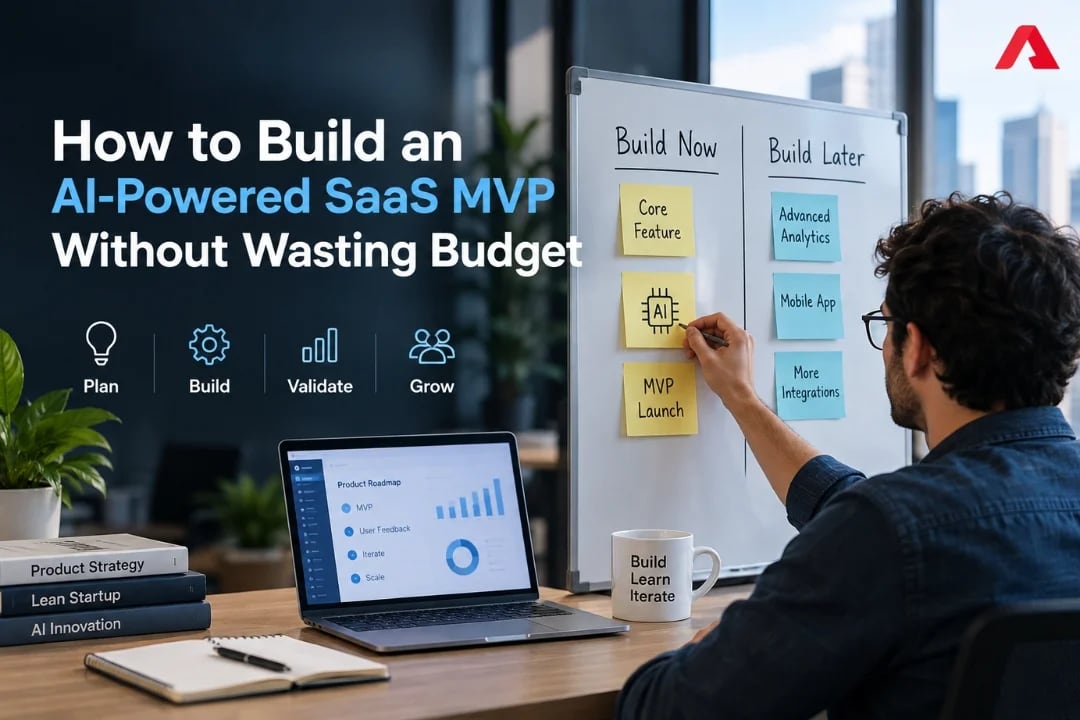
A founder came to us last year with a pitch deck, a $60,000 budget, and a feature list that would have cost $400,000 to build. Sound familiar? He wanted an AI-powered SaaS MVP with chat, predictions, dashboards, integrations, and a mobile app. Six months later he launched with one AI feature, spent $52,000, and signed his first ten paying customers. The other features are still on a list somewhere, and that is exactly where they belong.
This is the gap most founders fall into. AI makes the product idea more exciting, so the scope grows, the budget grows, and the launch date slips. Meanwhile the market moves on.
This guide walks through how to build an AI MVP the disciplined way: real cost ranges, the unit economics you must calculate before writing code, security designed in from day one, a week-by-week plan, and the mistakes that quietly drain budgets. It is written for founders who want to ship, learn from real users, and keep enough cash to iterate.
What Makes an AI-Powered SaaS MVP Different From a Normal MVP
A standard SaaS MVP is mostly deterministic. If the code is correct, the features work the same way every time.
An AI MVP adds uncertainty. The model can be wrong, and output quality depends on your data, your prompts, and the model you choose. That changes planning in three ways.
- You need a quality bar, not just a feature list."Summarize support tickets" is not done when the button works. It is done when the summary is right often enough that users trust it. Define "good enough" before you build.
- You need evaluation time in the schedule. Budget one to two weeks for testing and prompt tuning against real examples, and treat quality assurance as a core activity, not a final step.
- You have a new running cost. Every model API call costs money, and inference costs scale with usage. This deserves its own section, and it gets one below, because it is where AI products quietly succeed or fail as businesses.
The upside is real, though. Gartner projects that more than 80 percent of enterprises will have used generative AI APIs or deployed generative AI applications by 2026, up from less than 5 percent in 2023. The trick is adding intelligence where it changes the outcome for the user, not where it decorates the demo.
Validate the Idea Before You Write a Single Line of Code
Here is the uncomfortable data. CB Insights analyzed startup post-mortems and found that running out of cash was cited in 38 percent of failures and no market need in 35 percent. Harvard Business Review research by Tom Eisenmann adds that more than two thirds of startups never deliver a positive return to investors. Most of those products worked. They were just built for nobody.
So validate before you build, and not with a survey your friends fill out politely.
Run 15 to 20 problem interviews. Ask people who have the problem today what they currently do about it and what it costs them. If they are not already paying in time or money, they will not pay you.
Fake the product with no-code. Build a landing page, a Typeform, and an Airtable back end. For the AI part, run inputs through ChatGPT manually and email the results back. You learn whether the output is valuable before paying for engineering. Low-code and no-code tools can carry a concierge test surprisingly far.
Charge early. Even a $20 pilot fee filters out polite interest. One founder we worked with pre-sold 14 annual licenses from a Figma prototype.
Also protect the idea sensibly. Use an NDA when outsourcing app development before sharing details with vendors, and if the concept is genuinely novel, read up on how to patent an app idea.
Pick the One AI Feature That Actually Matters
This is where budgets go to die. Founders add AI features because investors expect them, not because users need them. We call it AI-for-show.
A simple test separates the two. Ask: if this AI feature disappeared tomorrow, would users churn?
AI is worth building when:
- It replaces a task users hate and do often, like drafting, tagging, or summarizing
- It makes a decision faster or more accurate, like scoring leads or flagging anomalies
- It is the core promise of the product, the reason people sign up
AI is a gimmick when:
- It is a chatbot bolted onto a product that works fine with normal navigation
- It generates content nobody asked for
- It exists mainly so the word "AI" can appear on the pricing page
The gap between adopting AI and getting value from it is wide. McKinsey's State of AI research found that 78 percent of organizations now use AI in at least one business function, yet only about 1 percent of executives describe their AI rollouts as mature.
Pick one AI capability. One. Make it excellent. A single feature that saves a user three hours a week beats five features that each save ten minutes. If that feature is conversational, a focused build with an experienced chatbot development team will outperform a general assistant. If it is predictive, start with the simplest machine learning approach that could work, even plain rules, before anything exotic.
Calculate AI Unit Economics Before Building
Here is the section most MVP guides skip, and the one that decides whether your product survives its own success. In a normal SaaS product, serving one more user costs almost nothing. In an AI product, every user action that touches a model has a real, metered cost. If you do not know that cost before you build, you are pricing blind.
Work through four numbers, on paper, before any code exists.
- Cost per AI action. Estimate the tokens (or image/audio units) one typical action consumes, in and out, and multiply by the model's price. A short summarization might cost a fraction of a cent. A long-document analysis with retrieval can cost several cents per run. Test with 20 real examples, not guesses.
- Actions per active user per month.How often will a real user trigger the feature? A daily-use drafting tool might mean 100 actions a month. A weekly report generator might mean 4. This number is usually the biggest surprise in the whole model.
- AI cost per active user. Multiply the two. This is the number to obsess over.
- Gross margin at your intended price. Subtract AI cost per user, hosting per user, and support per user from your monthly price. Healthy SaaS runs at 70 to 80 percent gross margin. If AI costs eat you below 50 percent, the business gets hard to fund, whatever the demo looks like.
A worked example makes it concrete:
| Line Item | Light Feature (Email Drafting) | Heavy Feature (Document Analysis with RAG) |
|---|---|---|
| Tokens per action (in + out) | ~2,000 | ~50,000 |
| Cost per action (mid-tier model) | ~$0.002 | ~$0.05 |
| Actions per user per month | 150 | 200 |
| AI cost per active user / month | ~$0.30 | ~$10.00 |
| Viable monthly price point | $15+ works easily | $49+ needed, usage caps advised |
| Margin risk | Low | High without guardrails |
The same feature can be a great business at $49 per month and a doomed one at $15. That is why unit economics come before scoping, not after launch.
Four levers bring the numbers down, and your team should be fluent in all of them:
- Model routing. Use small, cheap models for simple steps and reserve the expensive model for the hard step. Routine classification does not need a frontier model.
- Caching. Identical or near-identical requests should never hit the API twice.
- Context discipline. Send the model only what it needs. Trimming bloated prompts and retrieved chunks routinely cuts token spend 30 to 50 percent.
- Pricing design. Match price to cost: usage-based tiers, credits, or fair-use caps for heavy features. Flat unlimited pricing on top of a heavy AI feature is how margins disappear.
Run the numbers again at 10x and 100x your launch usage. If the business only works when model prices fall, say that out loud in your plan. Prices have been falling, but a plan that requires them to fall is a bet, not a strategy. This analysis takes one afternoon with an experienced AI product development team and can save a rebuild later.
Scope Ruthlessly: The MoSCoW Method
Scope creep is rarely one big decision. It is forty small ones. "While we are at it, can we add..." is the most expensive sentence in software.
MoSCoW is the simplest defense. Sort every requested feature into four buckets:
- Must have. The product fails its core promise without it. Login, billing, the one AI feature, and the minimum screens to use it. A true MVP usually has 5 to 8 must-haves.
- Should have. Important but survivable for launch. Team accounts, advanced settings, a second integration.
- Could have. Nice touches. Dark mode, export options, onboarding animations.
- Won't have (this release). Written down and agreed. This bucket is the whole point: it turns "no" into "not yet."
A practical rule we use in custom product development engagements: if the must-have list takes more than 12 weeks to build, it is not a must-have list. Cut again.
A true story: a healthtech founder insisted that multi-language support was a must-have because "we will expand to Europe." We moved it to Won't Have. Eighteen months later the product is thriving in one language, and no paying customer has ever requested that feature. Roughly $30,000 stayed in the bank.
Three Ways to Build: No-Code, API-First, or Custom Model
There are three sensible paths to build an AI MVP, and choosing the wrong one is the single most expensive decision you can make.
No-code or low-code. Tools like Bubble or Retool connected to an AI API. Fastest and cheapest, and great for validating demand. The trade-off: limited control, scaling ceilings, platform lock-in.
API-first on existing models. A custom application that calls OpenAI, Anthropic, or Google models through their APIs, often with retrieval (RAG) over your own data. For most early-stage AI SaaS products, API-first architecture is the pragmatic starting point: a real product, real ownership, strong AI quality, no training required. Good API and microservices architecture also makes it easy to swap models later as prices drop.
Custom or fine-tuned model. Only justified when your data is genuinely unique, per-call API costs would crush your margins at scale, or data cannot leave your environment for compliance reasons. Almost never the right MVP starting point.
| Factor | No-Code / Low-Code | API-First (Existing Models) | Custom / Fine-Tuned Model |
|---|---|---|---|
| Typical cost | $5,000 to $20,000 | $30,000 to $90,000 | $100,000 to $300,000+ |
| Time to launch | 2 to 6 weeks | 8 to 12 weeks | 4 to 9 months |
| AI quality control | Limited | High (prompts, RAG, model choice) | Highest, but hardest to reach |
| Scalability | Low to medium | High | High |
| Ownership and IP | Platform dependent | Full code ownership | Full ownership incl. model |
| Ongoing AI cost | Per-seat tool fees plus API usage | API usage based | Infrastructure plus ML team |
| Best for | Demand validation, concierge tests | Most funded MVPs | Unique data, strict compliance, scale economics |
The honest pattern: validate with no-code, launch API-first, and consider custom models only after revenue and your unit economics prove the case. Skipping straight to a custom model is how a $60,000 project becomes a $400,000 project.
What an AI-Powered SaaS MVP Really Costs
Founders ask about MVP development cost first, and most published numbers are either sales bait or fantasy. Here are honest 2026 ranges in USD for an API-first AI SaaS MVP with one core AI feature, authentication, billing, and an admin view.
| Approach / Team | Low End | High End | Notes |
|---|---|---|---|
| DIY founder with no-code tools | $2,000 | $10,000 | Your time is the real cost |
| Freelancers (2 to 3, self-managed) | $15,000 | $40,000 | Cheap until coordination fails |
| Offshore development partner (India) | $30,000 | $70,000 | Full team: dev, design, QA, PM |
| Onshore agency (US / UK / EU) | $80,000 | $200,000 | Same output, higher rates |
| In-house team (first 3 months) | $90,000 | $150,000+ | Salaries, hiring time, equipment |
| Add-on: custom model work | +$50,000 | +$150,000 | Only with proven need |
Then add running costs, which your unit economics work has already sized:
- Model API usage: $200 to $2,000 per month at early scale, depending on volume and model choice
- Cloud hosting: $100 to $800 per month for a typical early-stage stack on managed cloud services
- Tools and monitoring: $100 to $300 per month
- Maintenance and iteration: plan 15 to 20 percent of build cost per year, minimum
The market context helps justify the spend. Statista projects the global SaaS market at roughly $299 billion in 2025, and IDC expects worldwide AI spending to pass $630 billion by 2028. The question is whether your budget survives long enough to meet that demand.


Security Must Be Designed Into the MVP
"We will add security later" is the second most expensive sentence in software, right after "while we are at it." Retrofitting security into a live product costs multiples of building it in, and one incident can end an early-stage company's credibility with its first customers. Enterprise buyers, in particular, will send you a security questionnaire before they send you money.
Here is the baseline we consider non-negotiable for any AI SaaS MVP, even at week one:
- Authentication done properly. Use a proven identity service or library, enforce strong sessions, and offer SSO readiness if you plan to sell to companies. Never hand-roll password storage.
- Authorization and roles. Every API endpoint checks not just who you are but what you may touch. Admin, member, and read-only roles cover most MVPs.
- Tenant isolation. In a multi-tenant SaaS, one customer must never be able to query another customer's rows, files, or AI context. Enforce tenant scoping at the database and retrieval layer, and test it explicitly. This is the single most common gap we find when auditing MVPs built in a hurry.
- Encrypted secrets and data. API keys and credentials live in a secrets manager, never in code or config files. Encrypt data in transit and at rest.
- API rate limiting. Per-user and per-IP limits protect you from abuse, runaway scripts, and surprise AI bills at the same time.
- Audit logs. Record who did what and when, including every AI action taken on a user's data. When an enterprise prospect asks "can we see an access log?", the answer must be yes.
AI features add their own risks on top:
- Prompt injection. If your product feeds user-supplied content to a model, a malicious document can try to hijack the instructions. Separate system instructions from user content, and treat model output as untrusted input.
- Data leakage through prompts. Configure model providers so your customers' data is not used for training, and say so in your privacy policy. Know which regions your data touches for compliance.
- Output safety. Decide what the model must never do (expose other tenants' data, give legal or medical advice, execute actions without confirmation) and test those cases before launch.
None of this doubles your budget. Done from the start, this baseline adds days, not months, and it becomes a sales asset the first time a serious customer runs due diligence on you. We covered the deeper end of this topic, including agent permissions and action limits, in our guide to secure enterprise AI agents.
A Realistic 12 Week Timeline
Speed matters, but honest speed matters more. Here is a week-by-week plan we have run many times with a small dedicated team.
| Weeks | Phase | What Happens |
|---|---|---|
| 1 to 2 | Discovery and scope | Problem interviews reviewed, MoSCoW scoping, unit economics modeled, success metrics defined, architecture decided |
| 2 to 3 | Design | Wireframes, then high-fidelity screens for core flows only |
| 3 to 4 | AI proof of concept | Test the core AI feature against 50 to 100 real examples, tune prompts, pick the model, confirm cost per action |
| 4 to 8 | Core build | App skeleton, auth, roles, tenant isolation, billing, the AI feature wired in, admin basics |
| 8 to 9 | Integration and hardening | Edge cases, error states, rate limits, cost guardrails on AI calls, security review |
| 9 to 10 | QA and AI evaluation | Functional testing plus output quality testing against the agreed bar |
| 10 to 11 | Private beta | 10 to 30 real users, daily feedback, fast fixes |
| 11 to 12 | Launch prep and release | Analytics, onboarding polish, pricing live, public launch |
Two notes from experience. The AI proof of concept is the step most teams skip, yet if the model cannot hit your quality bar on 100 real examples, you want to know in week 4, not week 11. And if a plan promises all of this in 4 weeks, something is missing, usually QA and security.
The Tech Stack Conversation in Plain Language
You do not need to pick technologies yourself, but you should understand the conversation so nobody dazzles you with jargon.
Front end: what users see. React or Next.js are safe choices with deep talent pools, and any experienced web development company can staff them easily.
Back end: the engine. Node.js or Python. Python is convenient for AI-heavy products because most AI tooling is Python-first.
Database: where data lives. PostgreSQL covers almost every MVP. Add a vector database only if your AI feature searches your own documents.
AI layer: for most MVPs, API calls to a hosted model plus retrieval over your data. Ask your team two questions: "How do we measure output quality?" and "What happens to our cost per user if usage triples?" Good AI and ML development teams have crisp answers.
Hosting: managed cloud (AWS, Azure, or Google Cloud). At MVP stage, boring and managed beats clever and custom.
The guiding principle: choose boring technology everywhere except the one place your product is special. Your differentiation is the problem you solve, not the framework you picked.
Budget-Killing Mistakes We See Again and Again
After years of product work across industries, the same mistakes appear on repeat.
Building for imaginary scale. Microservices, Kubernetes, and multi-region setups for a product with zero users. A monolith on managed hosting serves your first 10,000 users fine.
Training a custom model on day one. The biggest single waste we see in AI product development.
Skipping the unit economics. Launching a heavy AI feature on flat pricing, then discovering every power user loses you money. Do the math before the build, not after the invoice.
Designing every screen before validating the core. Design the two flows that matter deeply, and let a focused UI/UX design process keep the rest lean.
No cost guardrails on AI calls. One retry loop bug can generate a five-figure API bill overnight. Set hard caps, per-user limits, and alerts in week one.
Treating security as a post-launch task. Tenant isolation and access control are architecture, not features. Bolting them on later means a partial rewrite.
Changing the target user mid-build. Pivoting from "for freelancers" to "for enterprise teams" invalidates design, pricing, and half the code. Pivot before you build or after you launch, not during.
Paying for a big team too early. Two strong engineers, one designer, and a part-time QA outperform a team of eight at MVP stage.
Skipping analytics. Launching without event tracking means your first month of real usage teaches you nothing.
None of these are technology failures. They are decision failures, which is good news, because decisions are free to fix on paper and expensive to fix in code.
Measuring Success After Launch
Launch is the starting line. The MVP exists to answer questions, so decide the questions in advance.
Activation rate: what share of signups reach the core "aha" moment, such as generating their first AI result?
AI feature engagement: do active users trigger the AI feature, and do they accept its output? If users constantly rewrite what the AI produces, the quality bar was set too low.
Week 4 retention: are users coming back a month later? This is the single most honest signal of value.
Willingness to pay: trials that convert, pilots that renew, and users who complain about pricing instead of ignoring it.
Cost per active user: your AI inference cost divided by active users, tracked against the unit economics model you built before writing code. If the real number runs ahead of the model, act early: routing, caching, and caps are much easier to add at 100 users than at 10,000.
Plan iteration before launch: a fix-and-polish release two weeks in, then a meaningful iteration every three to four weeks driven by these metrics. Teams that budget zero for post-launch work have built an expensive hypothesis with no way to act on the answer.
When to Bring In a Development Partner
Should you hire your own team or work with a partner? It depends on stage, and most founders get the timing backwards.
Hiring in-house makes sense when the product is validated, revenue is flowing, and you need people who live inside the domain for years. Recruiting a senior AI engineer alone can take three to six months. That is a scale-stage move.
A development partner makes sense when you need a full team, working now, for a fixed scope, without long-term payroll. You get engineers, a designer, QA, and project management from day one, and you can scale the team down after launch without layoffs.
What to check before signing with anyone:
- Ask for shipped AI products, not slide decks. Talk to a past client.
- Confirm you own all code and IP, and sign an NDA before deep discussions.
- Insist on weekly demos of working software. Progress reports without demos are fiction
- Ask how they test AI output quality. If the answer is vague, keep looking.
- Ask how they handle tenant isolation, secrets, and AI cost guardrails. Security answers reveal engineering maturity faster than any portfolio.
- Check that design, development, and QA are one accountable team, not three vendors pointing at each other.
Atharva System's startup services pair founders with a scoped team for the MVP phase, including generative AI development when the product calls for it. If your MVP has a mobile component, see our guide on building a successful mobile app startup.
Your Pre-Build Checklist
Do not brief a developer until you can tick every box. This one page saves more money than any negotiation.
Conclusion
Building an AI-powered SaaS MVP without wasting budget comes down to a handful of unglamorous decisions. Validate with real people before writing code. Pick one AI feature that removes real work. Model your AI unit economics before scoping, and design security in from week one, not after the first enterprise questionnaire. Build API-first on existing models, plan 8 to 12 weeks, and put cost guardrails on every AI call. Then measure, iterate, and let paying users tell you what to build next. Keep the scope small, the feedback loop short, and the spending visible every single week. The founders who win are rarely the ones who spent the most. They are the ones who learned the fastest per dollar spent.
Get Your AI SaaS MVP Estimate
Atharva System helps founders go from idea to launched product with one accountable team: custom product development, AI and ML engineering, UI/UX design, QA, and ongoing support after launch. We scope honestly, demo weekly, and you own every line of code.
Get a realistic scope, architecture, timeline, and development cost range before you commit to development. Share your idea and we will come back with the build approach we would take, the unit economics to watch, and an honest estimate, whether you build with us or not. Request your free MVP estimate today.
FAQs
1. How much does it cost to build an AI-powered SaaS MVP?
Typical ranges are $5,000 to $20,000 with no-code tools, $30,000 to $90,000 with an offshore development partner building API-first, and $80,000 to $200,000 with an onshore agency. Custom model development can add $50,000 or more and is rarely necessary at the MVP stage.
2. How long does SaaS MVP development take?
A focused API-first AI MVP typically takes 8 to 12 weeks with a small dedicated team. No-code validation can take 2 to 6 weeks, while projects involving custom AI models may take 4 to 9 months.
3. What is the difference between an AI MVP and a regular MVP?
An AI MVP includes features where outputs can vary based on the model, prompts, and data. This means you need to define acceptable output quality, test the AI against real examples, and account for ongoing model usage costs in addition to normal development requirements.
4. What are AI unit economics and why do they matter for an MVP?
AI unit economics measure how much each AI action costs and how those costs increase with user activity. Understanding cost per action and cost per active user helps you choose the right pricing model and avoid building an AI product that becomes too expensive as usage grows.
5. Do I need to train my own AI model for my MVP?
Usually, no. Most AI SaaS MVPs can start by using existing AI models through APIs. A custom or fine-tuned model should generally be considered only when your data, compliance requirements, product needs, or usage economics justify the additional investment.
6. How do I keep AI API costs under control?
Set spending caps, per-user rate limits, and usage alerts from the beginning. You can also reduce costs by caching repeated results, using smaller models for simpler tasks, and limiting unnecessary prompt and context data.
7. What security does an AI SaaS MVP need at launch?
An AI SaaS MVP should include proper authentication, role-based authorization, tenant isolation, encrypted secrets and data, API rate limiting, and audit logs. AI functionality should also be designed to reduce risks such as prompt injection and unintended exposure of customer data.