Picture a mid-sized auto parts manufacturer. Sixty people, three production sheds, and a sales team that still confirms orders over chat messages. The owner knows the business is leaking money somewhere between quotation and dispatch, but nobody can say exactly where. Sound familiar? This is exactly the kind of company that gains the most from digital transformation for SMEs, and in 2026 the smartest way to plan it is AI-first. The picture is the same whether that factory sits in Pune, Poland, or Pennsylvania.
AI-first does not mean buying an AI tool on day one. It means two things:
- You design every system you implement, from ERP to dashboards, so AI can plug in without rework later.
- You start capturing low-risk AI wins immediately, in parallel with the foundation work, instead of parking AI at the end of the plan.
This guide walks you through a realistic roadmap: how to assess readiness, what runs in sequence and what runs in parallel, what it costs, where agentic AI fits, and where SMEs go wrong. Everything here comes from patterns we see in real projects, not theory.
Why AI Changes the Equation for Smaller Companies
For twenty years, serious business technology favored large enterprises. A proper ERP rollout needed big budgets and in-house IT teams. SMEs made do with entry-level accounting software, Excel, and heroic effort.
AI has quietly flipped that in three ways.
- Adoption is now mainstream, not experimental. McKinsey's 2025 State of AI survey found that 88 percent of organizations now use AI in at least one business function, up from 78 percent a year earlier. When adoption is that broad, tooling gets cheaper and talent gets easier to find.
- The productivity gap is measurable. PwC's 2025 Global AI Jobs Barometer found that industries most exposed to AI recorded roughly four times higher productivity growth than less exposed industries, and workers with AI skills now command a 56 percent wage premium. Translation for an SME owner: your competitors who adopt early will out-produce you with the same headcount.
- Small firms are already moving. Microsoft reported in June 2025 that 71 percent of Canadian small and medium-sized businesses are actively using AI tools, and the OECD tracks the same rising curve across member countries. Wherever your SME operates, your customers and larger buyers now expect digital-grade responsiveness.
Here is the uncomfortable part. The same McKinsey research shows only a small minority of companies, around 6 percent, report meaningful bottom-line impact from AI at scale. Most are stuck in pilots. Why? They bolted AI onto messy processes and bad data. That is exactly what an AI-first roadmap prevents. Our digital transformation services page explains the approach we use with SME clients.
Digital Transformation for SMEs: An Honest Readiness Assessment
Before you spend anything, answer one question honestly: is your business ready to absorb change? Most transformation failures we see were predictable at the assessment stage.
Run this quick self-check. Score yourself on each row before talking to any vendor.
| Readiness Area | Green (Ready) | Amber (Fixable) | Red (Fix First) |
|---|---|---|---|
| Data | Core records live in one or two systems | Data split across Excel and email but recoverable | No consistent records, tribal knowledge only |
| Processes | WRITTEN SOPs exist for key workflows | Processes consistent but undocumented | Every employee does it their own way |
| Leadership | Owner sponsors the project personally | Owner supportive but delegating fully | Project pushed to one junior "IT person" |
| People | Team open to new tools, some digital comfort | Mixed comfort, needs training plan | Active resistance, high attrition |
| Budget | Funds reserved for 12 to 18 months | Budget for phase one only | Expecting results with near-zero spend |
| Systems | Modern cloud tools or a maintained ERP | Aging software that still runs | Unsupported legacy software, no backups |
If you score mostly red, do not start a large AI project. Start with basics:
- Document your top five processes
- Centralize customer and product data
- Get leadership aligned
The OECD's 2025 report on AI adoption by SMEs found that while adoption among smaller firms is rising fast, the large majority remain early-stage users held back by skills gaps, data readiness, and security concerns. The constraint is rarely the technology. It is the foundation underneath it.
If your legacy software is the weak point, a structured legacy modernization exercise usually comes before anything AI-related. Trying to train models on data trapped in a 2009 desktop application is a fast way to waste money.
One clarification, because it matters for the roadmap below. A red score blocks the deep AI work: forecasting on your ERP data, agents acting inside your systems. It does not block the shallow wins. Drafting quotes with generative AI or extracting data from supplier invoices needs almost no foundation at all. That difference is the heart of an AI-first plan.
The AI-First Roadmap: Foundation and Quick Wins in Parallel
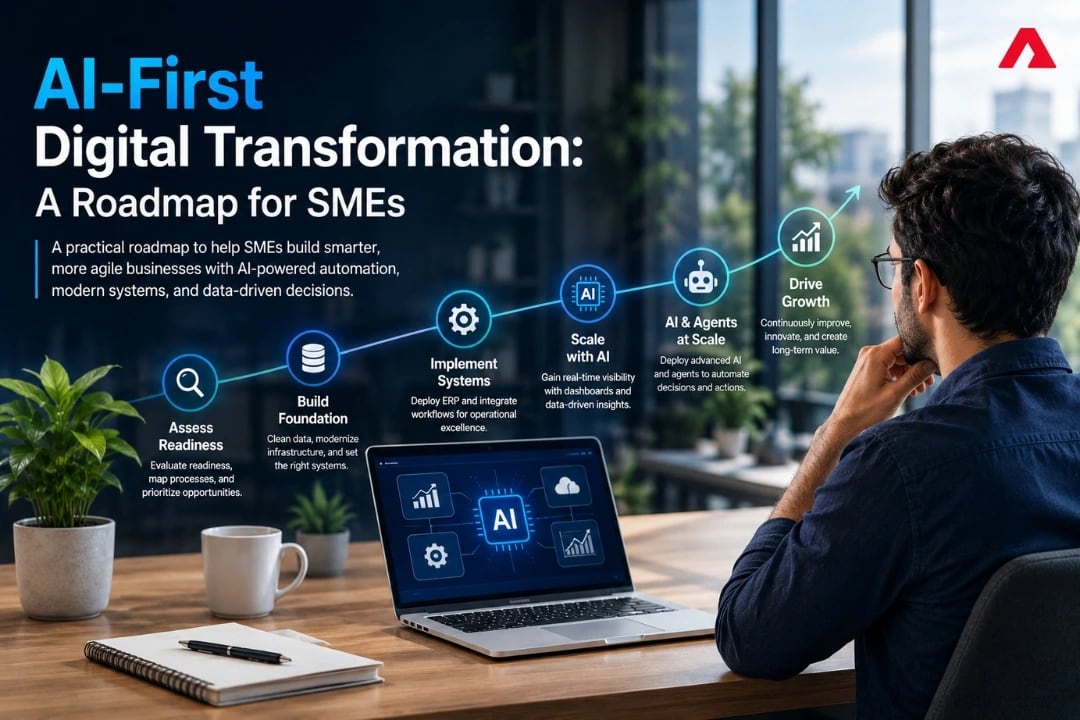
Here is the roadmap we recommend for a typical SME with 30 to 300 employees. It applies broadly to SMEs across India and global markets. Timelines assume steady sponsorship and one experienced partner. Stretch them by 30 to 50 percent if your team can only spare a few hours a week.
The roadmap runs on two tracks at once:
- The foundation track builds your systems in sequence: data, ERP, analytics.
- The AI quick-wins track starts in the very first weeks with low-risk tools that do not depend on clean central data. You do not need to wait 9 to 12 months to get your first AI result. You do need to wait before trusting AI with decisions that run on your core data.
| Phase | Foundation Track | AI Quick-Wins Track (parallel) | Typical Timeline |
|---|---|---|---|
| Phase 0 | Discovery and readiness audit, process map, priority use cases | Identify 2 or 3 low-risk AI wins alongside the audit | Weeks 1 to 4 |
| Phase 1 | Data cleanup, secure cloud setup | Document extraction, AI-drafted emails and quotes, meeting and call summaries | Months 2 to 4 |
| Phase 2 | ERP go-live, module by module | Support reply drafting, catalog and content generation on top of daily work | Months 4 to 9 |
| Phase 3 | Dashboards, live KPIs, exception alerts | AI-assisted report narratives, anomaly flags on fresh ERP data | Months 8 to 11 |
| Phase 4 | Deep AI on clean data: forecasting, quality inspection, custom models | Early agentic AI pilots on one bounded workflow | Months 10 to 14 |
| Phase 5 | Quarterly review cycle, scale what works | Expand agents and models to more workflows with governance | Month 14 onward |
-
- Phase 0: Discovery. Map how work actually flows, not how the org chart says it flows. Interview the people who do the work. Pick three to five problems where better systems would save money within a year. And shortlist the quick AI wins at the same time: anywhere staff retype information from documents or write the same kind of email twenty times a day is a candidate.
- Phase 1: Foundation, plus your first AI wins. Clean your master data: customers, items, prices, vendors. Move email, files, and backups to a managed cloud setup. A planned cloud migration here saves rework later, because every deeper AI capability will run on cloud infrastructure. In parallel, switch on the shallow wins, extract supplier invoice data automatically, Let generative AI draft quotations and follow-up emails for human review.
These tools work on documents as they arrive, so messy historical data does not hold them back. The team gets a visible AI win in month two, which builds appetite for everything that follows.
-
- Phase 2: Core systems. For most SMEs this means an ERP. We usually recommend Odoo development here because licensing is affordable, the modules cover sales through accounting, and it extends well when deeper AI features arrive.
Go live module by module: sales and invoicing first, then inventory, then manufacturing. A big-bang go-live across all departments is where SME projects die.
- Phase 3: Visibility. Once transactions flow through one system, build dashboards on top. A focused Power BI implementation gives owners daily visibility into cash, orders, stock, and receivables. Many clients tell us this phase alone paid for the whole program. Broader business intelligence work, such as combining ERP data with e-commerce data, fits here too.
- Phase 4: Deep AI on clean data. Now the high-value work opens up: demand forecasting, quality inspection, custom models, and the first agentic AI pilot. Because your data is clean and centralized, an AI and ML development project at this stage takes weeks, not quarters. Pick use cases with a measurable number attached.
- Phase 5: Scale. Review results quarterly. Retire what is not working, extend what is, and budget a small recurring amount for improvements.
The sequencing principle is simple: shallow AI that reads documents and drafts text starts now, in parallel. Deep AI that decides and acts on your core business data is earned with clean systems first.
Where AI Delivers Quick Wins for SMEs
Where does AI pay back fastest? In our experience, in the boring places. Here are examples by industry. The first two or three in each list can start in Phase 1, well before the ERP is live.
- Manufacturing.A machine shop drowning in RFQs can use generative AI to draft quotations from drawings and past pricing, cutting quote turnaround from three days to a few hours. That is a Phase 1 win. Demand forecasting on 24 months of sales data, a Phase 4 win, typically trims raw material inventory by 10 to 20 percent. Camera-based defect detection catches rejects before dispatch, not after a complaint.
- Retail and e-commerce. Product description generation and automated catalog tagging can start almost immediately. Reorder-point prediction comes later, on ERP data. One distributor we worked with used AI-driven sales analytics to spot that 30 percent of SKUs produced under 2 percent of margin. Cutting that tail freed working capital within a quarter.
- Healthcare. Clinics and diagnostic labs get early value from automated report summarization for referring doctors and document extraction that pulls patient details from scanned forms into the system. No-show prediction follows once appointment history is centralized. Every hour of front-desk typing removed is an hour returned to patients.
- Logistics. AI-assisted email handling is often the first win: a freight forwarder handling 200 booking emails a day can auto-classify and pre-fill 70 percent of them from week one. Route optimization and automated proof-of-delivery processing follow on centralized data. That is the difference between hiring two more coordinators or not.
- Two patterns run through all of these. The shallow wins attach to documents and text, which is why they can run early. And most combine plain automation with AI rather than AI alone, which is why we often scope them as intelligent automation projects. To see how these projects look in practice, browse our client work.
Agentic AI: When Your Systems Start Doing the Work
Everything above describes AI that assists: it drafts, extracts, and predicts, and a person completes the task. The next step, and the one we consider the strongest differentiator in our own delivery work, is agentic AI: software agents that carry a task end to end across your systems, with defined limits and human checkpoints.
The difference is easy to picture. A generative AI tool drafts a reply to a customer order email. An AI agent reads the email, checks stock and pricing in the ERP, creates the draft sales order, flags a credit-limit issue to the accounts owner, and sends the confirmation for one-click approval. The person supervises outcomes instead of pushing every step.
For SMEs, the practical early agent use cases look like this:
- Order intake agent - Reads incoming purchase orders and emails, matches items and prices against the ERP, and creates draft orders for approval. Removes the retyping that causes most order errors.
- Receivables follow-up agent - Watches overdue invoices, sends escalating reminders on schedule, answers basic statement queries, and alerts a human when a customer disputes or goes quiet.
- Procurement agent - Monitors stock against reorder rules, drafts purchase orders to approved vendors, and asks for sign-off above a value threshold.
- Service triage agent - Classifies support requests, resolves the routine ones from a knowledge base, and routes the rest with full context attached.
Two honest cautions from our agentic AI delivery experience. First, agents act, so they inherit the quality of the systems they act on. An agent working against clean ERP data is an asset. An agent working against five conflicting spreadsheets is a liability. This is why agent pilots sit in Phase 4 of the roadmap, even though the appetite for them usually arrives much earlier. Second, agents need governance from day one: clear permissions, action limits, audit logs, and human approval on anything irreversible. We covered the security side in depth in our guide to secure enterprise AI agents.
Start with one bounded workflow, one agent, one owner, and a weekly review of what it did. Expand only after a full month of clean logs. Done this way, agentic AI is where SMEs recover the most hours per rupee or dollar spent, because it removes whole task chains rather than single steps.
Budgeting and ROI: What to Actually Expect
Money talk. SME owners deserve straight numbers. The roadmap applies globally; the cost examples below use India-based delivery rates as a reference point, which is also why so many international SMEs work with India-based delivery teams. USD figures are indicative equivalents and vary with exchange rates. Exact costs depend on user count, customization, and data condition.
| Investment Item | Typical INR Range | Indicative USD Range | Notes |
|---|---|---|---|
| Discovery and readiness audit | 1.5 to 4 lakh | ~$2,000 to $5,000 | Sometimes credited against the project |
| Data cleanup and cloud setup | 2 to 6 lakh | ~$2,500 to $7,500 | Depends heavily on data condition |
| AI quick wins (documents, drafting) | 2 to 8 lakh | ~$2,500 to $10,000 | Can start in Phase 1; payback in 6 to 9 months |
| Odoo ERP implementation (10 to 50 users) | 8 to 40 lakh | ~$10,000 to $50,000 | Licensing extra; phased rollout advised |
| Power BI dashboards and analytics | 3 to 12 lakh | ~$4,000 to $15,000 | Includes data modeling and training |
| One deep AI or agentic use case | 8 to 35 lakh | ~$10,000 to $45,000 | Scope tightly; start with one workflow |
| Annual support and improvement | 15 to 20% of build cost | 15 to 20% of build cost | Budget this from day one |
A full first-year program for a 50-person company usually lands between INR 25 lakh and INR 75 lakh, approximately US$30,000 to $90,000 depending on exchange rates, spread across phases. That number scares some owners until they see the market context. IDC forecasts worldwide digital transformation spending to reach almost 4 trillion dollars by 2027, and Statista's tracking shows global spending climbing through 2028. Your larger competitors and customers are inside that number. The cost of staying manual is simply less visible than the cost of a project.
For a detailed breakdown of ERP pricing specifically, see our guide on Odoo ERP implementation cost.
How Should You Think About ROI? Use Three Buckets:
- Hard savings: headcount hours saved, inventory reduction, fewer penalties and errors. Demand these in a business case.
- Revenue effects: faster quotes, better availability, fewer lost leads. Estimate conservatively.
- Risk and resilience: audit readiness, less key-person dependency, data security. Hard to price, easy to regret ignoring.
A reasonable target: hard savings alone should recover Phase 1 to 3 costs within 18 to 24 months, and the parallel AI quick wins should each pay back inside 9 months. If a proposal promises full payback in 3 months, be skeptical. If it cannot show any payback path within 3 years, walk away.
One more tip. If cash is tight, ask about low-code and no-code development for internal tools. It cuts build costs sharply for approval workflows, field data capture, and simple portals, keeping your custom budget for what truly differentiates you.
Common Mistakes SMEs Make
We have audited plenty of stalled projects. The same mistakes show up again and again.
| Mistake | What It Causes | The Fix |
|---|---|---|
| Buying tools before mapping processes | Shelfware, duplicate subscriptions | Do Phase 0 discovery first, always |
| Big-bang ERP go-live | Chaos, staff revolt, rollback to Excel | Phase the rollout module by module |
| Deep AI before data is ready | Pilots that never scale, wasted spend | Run shallow AI early, earn deep AI with clean data |
| Skipping AI entirely until "later" | Team never builds AI habits, momentum dies | Start low-risk quick wins in Phase 1 |
| No named internal owner | Vendor drift, decisions stall for weeks | Appoint one accountable project owner |
| Customizing everything | Ballooning cost, painful upgrades | Adapt processes to standard where possible |
| Ignoring training budgets | Low adoption, shadow spreadsheets return | Reserve 10 to 15% of budget for training |
| Choosing the cheapest vendor | Rework, abandoned code, second project | Evaluate on references and industry fit |
| No success metrics defined | Nobody can say if it worked | Set 3 to 5 measurable KPIs in Phase 0 |
The customization trap deserves special mention. SMEs often insist the software must mirror their current process exactly. But some of those processes exist only because old tools forced them. Ask of each customization: does this step make us money, or is it habit? Genuine differentiators justify custom software development. Habits do not.
Change Management and User Adoption
Here is a truth most proposals skip: the technology is the easy half. The hard half is a 48-year-old dispatch supervisor who has run the plant from a notebook for 20 years and sees your new system as an insult.
If he quietly refuses to use it, your project fails, whatever the software costs. So plan for people from day one.
- Explain the why before the what. People resist what they suspect threatens them. Tell the team plainly what the project is for, and say clearly whether roles will change. This matters double for AI agents, which people fear more than dashboards. Show the agent's audit log openly so the team sees exactly what it does and does not do.
- Recruit champions, not just users. Involve one respected person per department in design decisions. When the dispatch supervisor helps design the dispatch screen, he defends it instead of fighting it.
- Train in the flow of work. Two-hour classroom sessions are forgotten by Friday. Short sessions at the person's own desk, using real orders and real customers, stick.
- Run parallel briefly, then commit. A short parallel run builds confidence, but set a hard cutover date. Indefinite parallel running means the old way wins.
- Measure adoption, not just delivery. Track logins, transactions entered, and dashboard views weekly for the first 90 days. Falling usage is an early warning you can still act on.
- Celebrate early wins loudly. When the first month-end closes in 3 days instead of 12, tell everyone. The early AI quick wins help here too: a sales rep whose quotes now draft themselves becomes your loudest advocate. Momentum is a management tool.
Expect a productivity dip for 4 to 8 weeks after each go-live. Owners who panic and allow "temporary" Excel workarounds usually never recover the project. Hold the line, support the strugglers, and the curve turns.
How to Choose a Digital Transformation Partner
Most SMEs cannot and should not build an internal team for this, so the partner decision is the biggest single risk in the program. Whether you are evaluating a large digital transformation company or a boutique firm, test these things:
- SME delivery experience, not just enterprise logos. Enterprise methods drown small companies in documentation. Ask for references from companies your size and industry, then actually call them.
- Full-stack capability under one roof. Your roadmap spans ERP, cloud, analytics, AI, and now agents. A partner who covers process consulting through data analytics services, AI delivery, and agentic AI saves you from managing four vendors who blame each other.
- A discovery-first approach. A partner who quotes a fixed price before studying your processes is guessing. Good digital transformation consulting starts with questions, not a demo.
- Product-agnostic advice with named skills. Beware the vendor whose answer to everything is the one product they resell. Equally, demand certified depth in whatever they do recommend, whether that is Odoo, Power BI, or a platform like Microsoft Fabric. Our take on where analytics platforms are heading is in this piece on Microsoft Fabric in the AI era.
- Knowledge transfer built into the contract. You should get admin training, documentation, and source code access. If the proposal creates permanent dependency, negotiate or move on.
- Support terms in writing. Response times, escalation paths, and improvement hours for at least the first year.
Ask each shortlisted partner one revealing question: "Tell me about a project that went wrong, and what you changed afterward." Honest answers signal a partner. Polished denial signals a salesperson.


Your Pre-Launch Checklist
Before you sign anything, confirm every item below. Ten minutes here saves months later.
- Top five business processes documented, even roughly
- Three to five measurable goals agreed by leadership (with target numbers)
- Two or three low-risk AI quick wins shortlisted to run in parallel with the foundation
- One named internal project owner with real authority
- Master data audit done: customers, items, vendors, prices
- 12 to 18 month budget approved, including training and support
- Phase plan agreed: foundation plus quick wins, ERP, analytics, then deep AI and agents
- Department champions identified and informed
- Partner references checked with at least two similar-sized companies
- Success KPIs and review dates written into the contract
- Data backup, access control, and security responsibilities assigned
- Hard cutover dates set for each go-live
- Quarterly review cycle scheduled for the first year
Conclusion
Digital transformation for SMEs is no longer a luxury project for someday. Adoption data from McKinsey, PwC, and the OECD all point the same way: AI is now mainstream, the productivity gap is real, and the firms that prepared their data and systems are the ones collecting the returns. The good news is that the roadmap is not mysterious. Assess honestly, run low-risk AI wins in parallel from the first weeks, build the foundation, implement a right-sized ERP, add analytics, then deploy deep AI and agents where the numbers justify it. Sequence beats speed, but parallel beats waiting. Start small, measure everything, and keep your people at the center of the plan. Do that, and an AI-first transformation is well within reach of a company your size, wherever you operate.
Ready to Build Your AI-First Roadmap?
Atharva System has helped SMEs and growing enterprises plan and deliver transformation for over two decades. Our team handles the full path described in this article: digital transformation consulting, Odoo ERP implementation, AI development, agentic AI, Power BI dashboards, and business automation, all under one roof. We work with startups finding product-market fit and with established enterprises modernizing decades of systems.
Not sure where your company stands? Start with a free consultation. We will review your processes, score your readiness, flag the AI quick wins you could start this quarter, and give you a phased plan with honest cost estimates, whether you build with us or not. Talk to our digital transformation experts today.
FAQs
1. What is AI-first digital transformation?
It is a way of planning transformation where every system you implement is chosen and structured so AI can use its data later, while low-risk AI tools start delivering value from the first phase. The deep AI work comes later, but AI thinking and AI quick wins start on day one.
2. How long does digital transformation take for an SME?
A typical program runs 12 to 18 months from discovery to deep AI use cases in production. The first AI quick wins land much earlier, usually within the first two to three months, so you are not waiting until the end for returns.
3. How much does digital transformation cost for a small business?
The roadmap applies to SMEs in any market; using India-based delivery rates as a reference, a realistic first-year range for a 30 to 100 person company is INR 25 lakh to 75 lakh, approximately US$30,000 to $90,000 depending on exchange rates. A single AI quick win or automation pilot can start around INR 2 to 8 lakh.
4. Should an SME start with AI or with an ERP?
Both, on separate tracks. Start low-risk AI tools like document extraction and quote drafting immediately, because they do not depend on clean central data. Hold the deep AI work, forecasting and agents, until your ERP and data foundation are in place, usually 9 to 12 months in.
5. What is the best ERP for small and medium businesses?
For most SMEs we recommend Odoo. It covers sales, inventory, accounting, manufacturing, and HR in one system, licensing is affordable, and it integrates well with analytics, AI tools, and agents.
6. What are the fastest AI wins for SMEs?
Document data extraction, quotation and email drafting, catalog content generation, support reply drafting, and meeting summarization. Each attaches to a clear metric like hours saved, and none requires a finished ERP to start.
7. What is agentic AI and is it relevant for SMEs?
Agentic AI means software agents that complete tasks end to end across your systems, like reading order emails and creating draft sales orders in the ERP, with human approval on key steps. It is very relevant for SMEs because it removes whole task chains, but it should run on clean systems with clear limits and audit logs.
8. How do I know if my company is ready for digital transformation?
Check three things: your key processes are consistent enough to document, your core business data can be gathered into one place, and leadership will sponsor the project personally. If any of these fails, fix it first, while still running the low-risk AI wins.
9. What ROI should I expect from digital transformation?
Aim for hard savings that recover your foundation and ERP costs within 18 to 24 months. The parallel AI quick wins should each pay back inside 9 months, and analytics typically pays back within 6 to 12 months of go-live.
10. Why do so many digital transformation projects fail?
The usual causes are skipping process discovery, big-bang rollouts, weak internal ownership, and ignoring user adoption. Technology failure is rare. People and planning failures are common and preventable.
11. Do SMEs need a dedicated IT team for this?
No. Most SMEs run successfully with one internal project owner plus an external partner for implementation and support. What you cannot outsource is decision-making and sponsorship.
12. Is cloud necessary for AI adoption?
Practically, yes. Modern AI services and agents run in the cloud, and cloud infrastructure gives SMEs enterprise-grade security and backups without capital expense. Moving early makes every later phase cheaper.
13. How do I measure user adoption after go-live?
Track weekly logins, transactions entered per user, dashboard views, and the number of processes still living in spreadsheets. For AI agents, review the action logs weekly. Watch all of it for the first 90 days and act quickly when usage dips.