Here is a scene that plays out in boardrooms every week. The CEO comes back from a conference and says the company needs AI. The CTO agrees but has a backlog full of other work. Marketing wants a chatbot. Finance wants forecasting. Nobody agrees on where to start, what it will cost, or who will own it. Six months later, nothing has shipped.
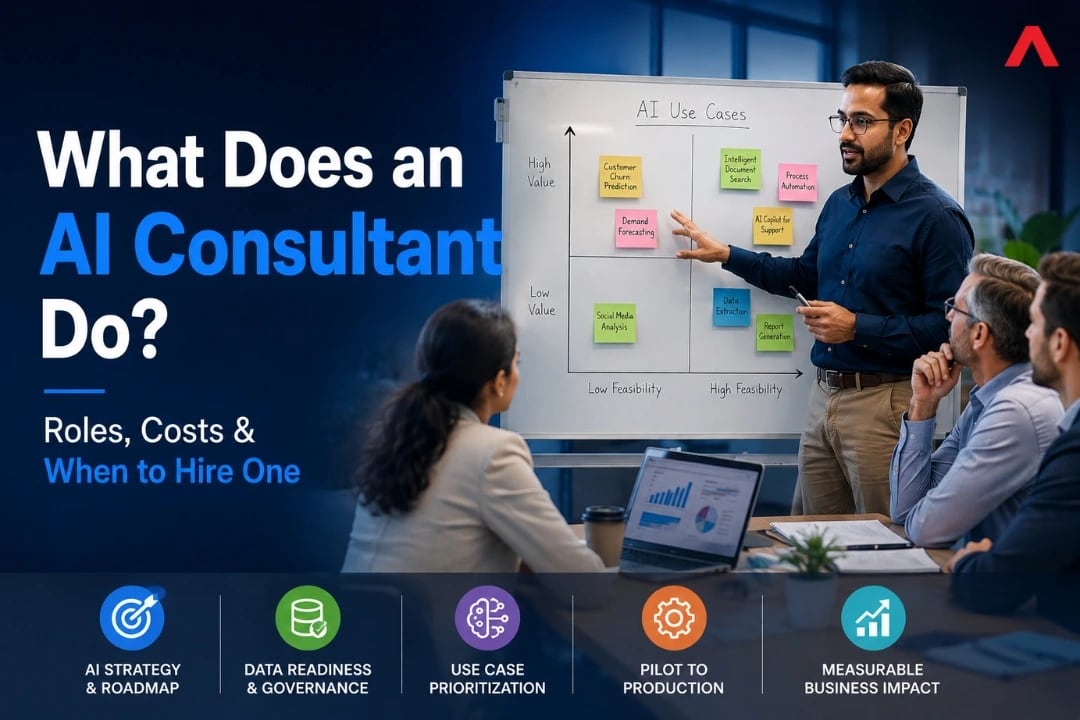
This is exactly the gap an AI consultant fills. An AI consultant helps a business figure out where AI will actually create value, checks whether the company's data and teams are ready, and then guides the work from idea to a working system. Good consultants also tell you which AI ideas to drop, which is often the most valuable part.
The stakes are real. Gartner predicts that at least 30 percent of generative AI projects will be abandoned after proof of concept, mostly due to poor data quality, weak risk controls, and unclear business value. This guide explains what AI consultants do all day, the technical work behind the advice, what an engagement costs, and how to know if you need one at all.
What an AI Consultant Actually Does Day to Day
The title sounds vague, so let's make it concrete. Across a normal month, an AI consultant does six kinds of work.
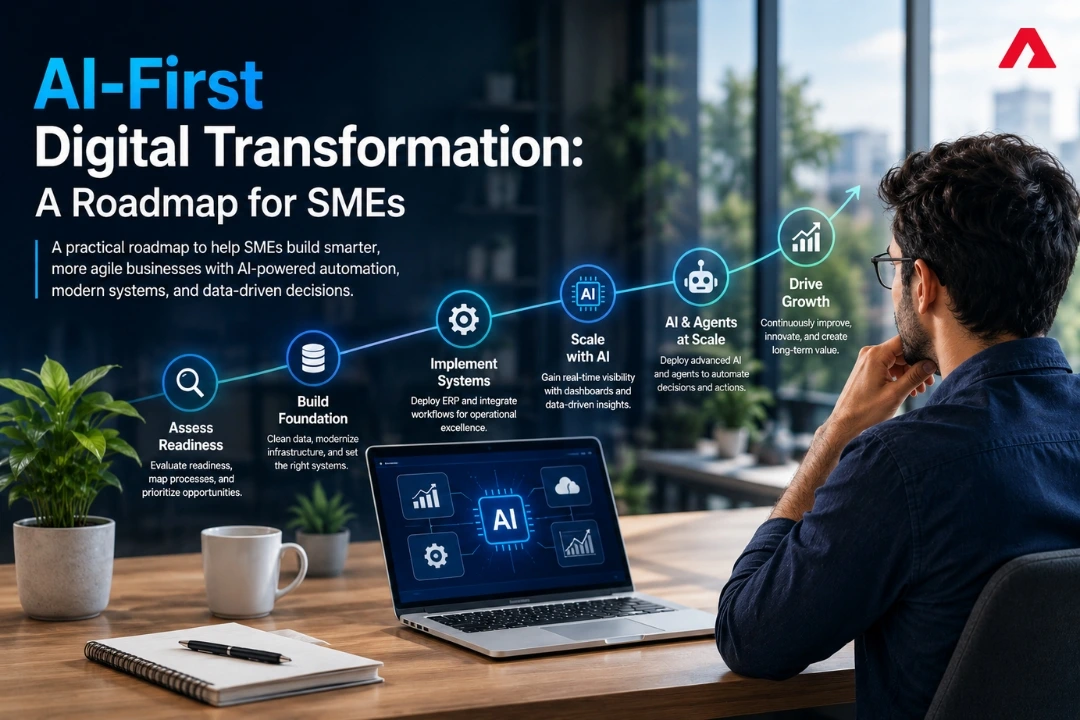
- AI strategy and roadmap building The consultant sits with leadership and maps business goals to AI opportunities. Not the other way around. The output is usually a 12 to 18 month roadmap: what to build first, what to buy instead, what to ignore for now. For SMEs, this process can be structured around an AI-first digital transformation roadmap that connects AI initiatives with broader business and technology priorities. This is the core of AI strategy consulting, and where most engagements begin.
- Use case selection and prioritization Every company has more AI ideas than budget. The consultant scores each idea on business value, technical feasibility, data availability, and risk. In our workshops at Atharva System, a list of 30 ideas usually shrinks to 3 or 4 worth funding. The rest go on a parking lot list, and that is a good outcome, not a failure
- Data readiness assessment AI runs on data, and most company data is messier than leadership thinks. A consultant audits where data lives, who owns it, how clean it is, and whether it can legally be used for the intended purpose. Sometimes the honest recommendation is to spend the first quarter on data analytics foundations before touching any model.
- Vendor and platform selection Should you use OpenAI, Anthropic, or an open source model? Microsoft Fabric or a custom pipeline? Build or buy? A vendor-neutral AI consultant runs structured evaluations instead of picking whatever a sales rep pitched last week. Many teams we meet are already comparing options like Microsoft Fabric for analytics and AI and need an outside view on fit and cost.
- Pilot oversight Once a use case is funded, the consultant defines success metrics before a line of code is written, keeps the pilot scoped tight, and reviews progress weekly. A pilot without a metric is just a demo. Demos do not survive budget season.
- Governance, risk, and responsible AI Someone has to answer the uncomfortable questions. What happens when the model is wrong? Who reviews outputs? How do we handle customer data? Consultants set up review processes, model monitoring, and usage policies. This matters even more when deploying secure enterprise AI agents that can take actions on their own.
The Technical Work Behind the Advice
Strategy slides are the visible part of the job. What separates a real AI consultant from a presentation firm is the technical judgment underneath. Here is the work that happens behind the roadmap.
Architecture decisions that shape cost for years. Should your knowledge assistant use retrieval augmented generation (RAG) over your documents, a fine-tuned model, or a plain prompt with a large context window? Each option carries a different build cost, accuracy profile, and monthly bill. In one enterprise engagement, we replaced a planned fine-tuning project with a RAG pipeline over the client's existing document store. Accuracy targets were met and the build cost dropped to roughly a third of the original estimate, because nothing had to be retrained when documents changed.
Integration mapping. An AI feature that cannot read your ERP, CRM, or ticketing system is a toy. Consultants map which systems the AI must connect to, whether APIs and microservices exist or must be built, and where humans stay in the loop. This is usually where the real effort estimate comes from, not the model.
Model evaluation before launch. How do you know the AI is good enough to face customers? We set an accuracy threshold with the business first, then build a test set from real historical cases and measure against it. If the model clears the bar, it ships. If not, it stays internal with human review. Skipping this step is how embarrassing screenshots end up on social media.
Running cost modeling. LLM usage is metered. A feature that costs $80 in a demo can cost $8,000 a month at production traffic. Part of the consulting work is projecting token usage, caching strategy, and model tier choices so finance is not surprised in month three.
None of this requires the client to become technical. It requires the consultant to be technical enough to make these calls and explain them in plain language.


What a Typical AI Consulting Engagement Looks Like
Let me walk you through how this actually runs, because most articles skip the practical part.
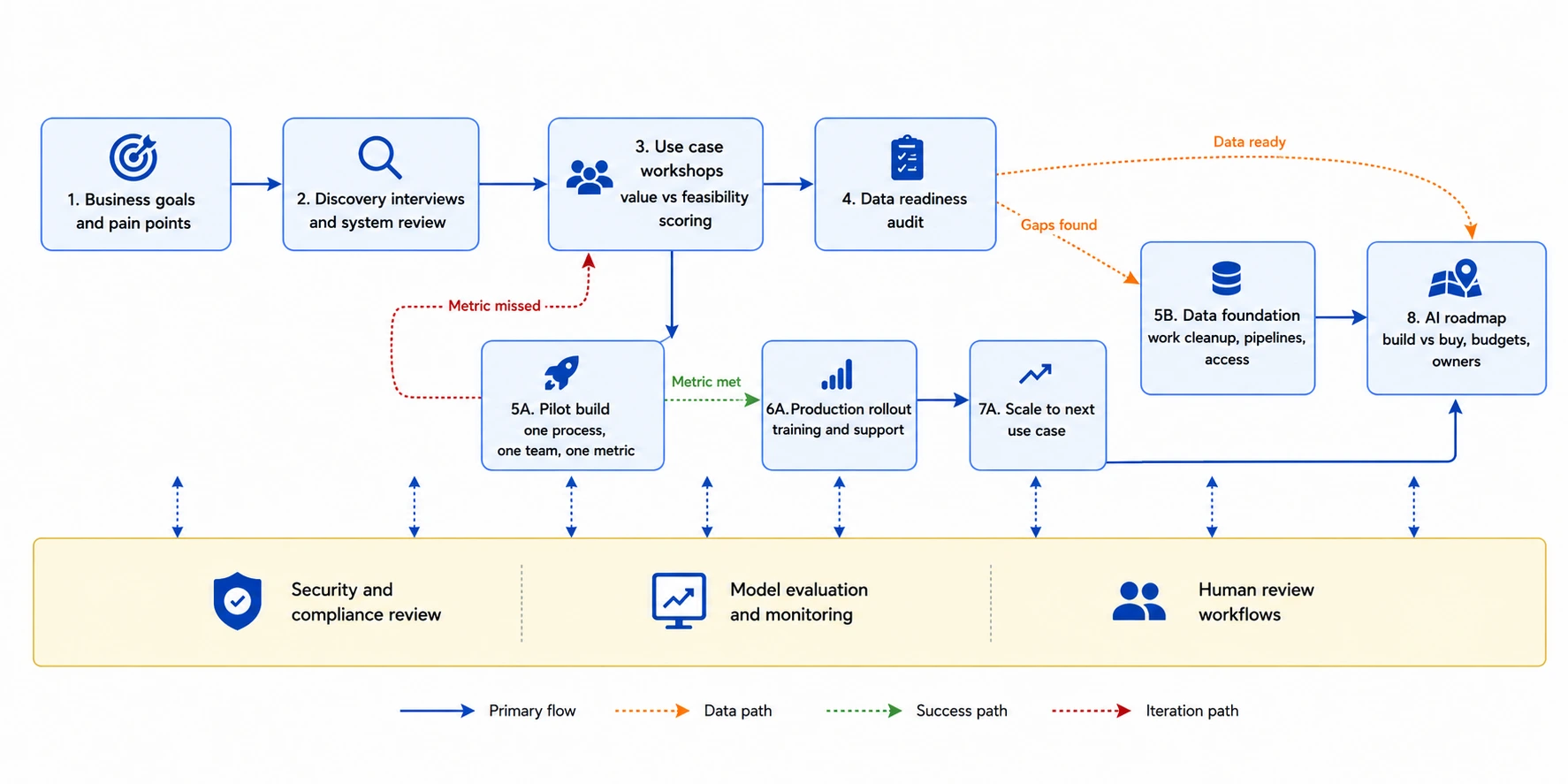
Week 1 is mostly listening. The consultant interviews department heads, reviews systems, and asks for sample data. No slides yet. The goal is to find where money leaks: manual processes, slow decisions, repeated errors, missed sales. Anyone who arrives in week 1 with a ready-made solution has not done this job for long.
Then come the discovery workshops. These are half-day sessions with mixed teams: operations, IT, finance, and frontline staff. Frontline staff matter most, because they know where the real friction is. Candidate use cases go on a simple grid: value on one axis, feasibility on the other.
Next is the data audit. For the top use cases, the consultant checks whether the required data exists, is accurate, and is accessible. This step kills more AI ideas than any other. And that is fine. An idea killed in week 3 costs a few thousand dollars. The same idea killed in month 9 costs a few hundred thousand.
Then the roadmap, then the pilot. The roadmap ranks use cases, estimates costs and returns, and names owners. The first pilot stays small: one process, one team, one metric. If it works, you scale. If not, you learned something cheap.
Here is the typical timeline.
| Phase | Duration | What Happens | Key Deliverable |
|---|---|---|---|
| Discovery | 1 to 2 weeks | Stakeholder interviews, system review, pain point mapping | Findings summary |
| Use Case Workshops | 1 to 2 weeks | Idea collection, value vs. feasibility scoring | Prioritized use case list |
| Data Readiness Audit | 2 to 3 weeks | Data quality, access, ownership, and compliance checks | Data readiness report |
| AI Roadmap | 1 to 2 weeks | Sequencing, budgets, ROI estimates, build vs. buy decisions | 12 to 18 month roadmap |
| Pilot Build | 6 to 12 weeks | One scoped use case built and tested with real users | Working pilot plus metrics |
| Scale and Governance | Ongoing | Rollout, training, monitoring, and policy setup | Production system plus playbook |
Engagement workflow diagram
The following diagram shows the full flow, including the governance layer that runs alongside delivery. (Mermaid source below for the design team; render as a branded graphic for the published page.)
One more thing from experience: a good consultant says no a lot. No, a chatbot will not fix churn if the product is broken. No, you do not need a custom model when a configured tool costs a tenth as much. Vendors rarely say no. That alone can justify the fee.
Strategy Consultant vs Implementation Partner
People use "AI consultant" to mean different things, and mixing them up leads to bad hires.
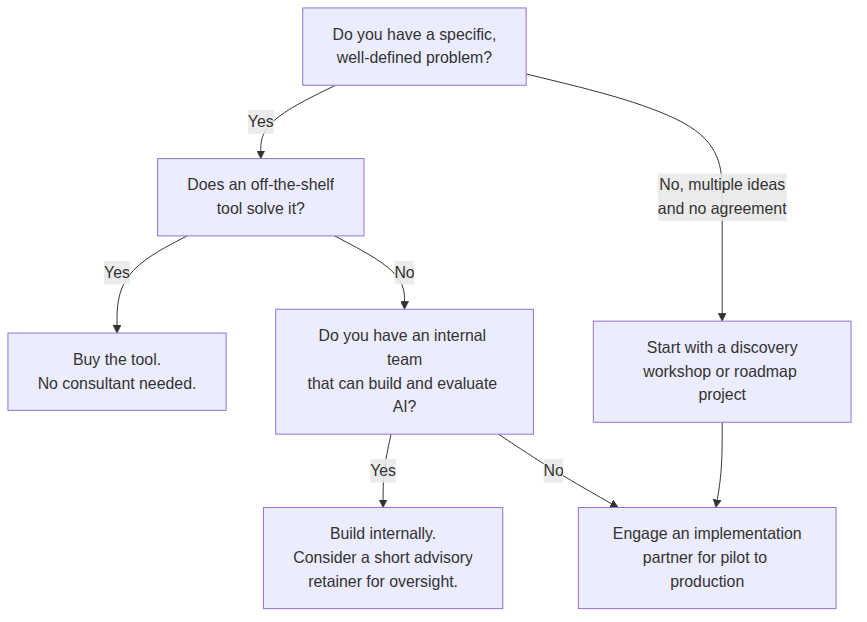
A strategy consultant advises. They produce the roadmap, the vendor shortlist, and the business case, but they do not write production code. An implementation partner is an AI consulting company that both advises and builds, taking a use case from idea to deployed system with their own engineers. A third option, staff augmentation, means renting individual machine learning engineers who work under your direction. It only makes sense when you already have a clear plan and strong internal leadership, so most companies searching for an AI consultant are really choosing between the first two.
| Strategy Consultant | Implementation Partner | |
|---|---|---|
| What you get | Advice, roadmap, vendor selection | Strategy plus a built, working system |
| Best when | You need direction before spending | You lack an internal AI team |
| Accountability | For recommendations | For outcomes and delivery |
| Typical cost | $15,000 to $75,000 per project | $50,000 to $250,000 or more |
A quick note on neutrality. Pure advisors are easiest to trust on tool selection because they do not profit from the build. Implementation partners can still give honest advice, but ask how they get paid and whether they earn reseller commissions on the platforms they recommend. The good ones answer without flinching.
Many mid-sized companies choose a hybrid: a short strategy phase, then the same firm builds the top use case. That works well as long as the strategy phase produces a standalone deliverable you could take elsewhere.
Signs You Need an AI Consultant (and Honest Signs You Do Not)
You probably need one if:
- Leadership wants AI but there is no agreed starting point. Everyone has an idea, nobody has a plan, meetings go in circles.
- You tried a pilot and it stalled. MIT research reported by Forbes found that about 95 percent of enterprise generative AI pilots show no measurable ROI. Most stall for organizational reasons, not technical ones.
- Your data is scattered. If reporting is still a monthly spreadsheet fight, you need business intelligence groundwork, and a consultant can sequence that correctly.
- A big vendor decision is coming. Committing to a platform for five years without an independent evaluation is how expensive regret happens.
- You cannot hire AI talent fast enough. The World Economic Forum's Future of Jobs Report 2025 found that 63 percent of employers see skills gaps as the biggest barrier to transformation. Consulting buys you senior judgment while you build the internal team.
- Compliance is at stake. Healthcare, finance, and insurance firms should not improvise AI governance
You probably do not need one if:
- You have one small, well-defined problem. If you just want meeting transcription or basic document search, buy an off-the-shelf tool and move on.
- You already have a strong data science team with executive backing. Give them room instead of layering advisors on top.
- You have no budget to act on advice. A roadmap you cannot fund is an expensive PDF. Wait until you can invest in at least one pilot.
- You want AI for the press release. A consultant cannot fix a motivation problem.
Honest firms say this in the first call. If a consultant insists every company needs a big engagement, that tells you something.
Do you need an AI consultant? A quick decision flow
What AI Consulting Costs
Fees vary a lot by region, seniority, and scope, but here are realistic 2026 ranges. India-based firms with global delivery experience typically come in 40 to 60 percent below US or UK rates for comparable senior talent, which is why so many mid-market companies look there first.
| Engagement Model | Typical Scope | Typical Fee Range | Best For |
|---|---|---|---|
| Discovery Workshop | 1 to 3 days, use case scoring, quick wins list | $2,000 to $10,000 | Testing fit before committing |
| AI Strategy and Roadmap | 4 to 8 weeks, audits plus full roadmap | $15,000 to $75,000 | Companies starting from zero |
| Monthly Advisory Retainer | 20 to 60 hours per month of senior guidance | $3,000 to $15,000 per month | Ongoing oversight of internal teams |
| End-to-End Pilot to Production | Strategy plus build, deploy, and training | $50,000 to $250,000 or more | Companies without an AI engineering team |
Independent AI consultants charge $100 to $400 per hour in Western markets. Big strategy firms charge multiples of everything above.
Is it worth it? Compare the fee to the cost of failure. IDC expects worldwide AI spending to reach $632 billion by 2028. That money will split into two piles: planned spend that returns value, and improvised spend that does not. Consulting fees are small next to a failed six-figure build.
One practical tip: start with the smallest paid engagement, usually a workshop. You will learn how the consultant thinks before signing anything large.
How to Evaluate and Choose an AI Consultant
Most buyers have never bought AI consulting services before. Here is what separates the good ones.
Questions to ask:
- Can you show two projects like ours, with business results, not just the tech stack? Ask to see a portfolio of real work.
- Which past recommendation was "do not build this"? Good consultants have several stories.
- Who exactly will work on our account? Get names, not just the partner who sold the deal.
- How do you measure success, and will you commit to those metrics in the contract?
- Do you earn commissions from any vendor you might recommend?
- What happens to our data, prompts, and models when the engagement ends?
- Can you work with our existing stack, including tools like Power BI, instead of forcing a replacement?
Red flags:
- Guaranteed ROI numbers before seeing your data. Nobody honest promises 300 percent returns in a sales call.
- A pitch full of model names and no questions about your business.
- One-size-fits-all packages with no discovery phase.
- No willingness to talk about failure cases, governance, or what could go wrong.
- Pressure to sign a long contract before a small paid pilot.
- They cannot explain their methods in plain language. If the sales process confuses you, imagine the project.
Also check depth beyond chatbots. A capable partner should cover generative AI, agentic AI, classic data science, and intelligent automation, because your best use case may not be the fashionable one.
What Happens When Companies Skip Strategy
We get called in to rescue projects, so we see the same patterns repeatedly. Three come up more than any others.
The data surprise. A team spends four months on a forecasting model, then discovers the historical data has gaps, duplicates, and a field that changed meaning in 2022. The model was fine. The data was not. A two-week audit would have caught it.
The tool-first trap. Someone buys an enterprise AI platform, then hunts for problems to justify it. Adoption stays near zero, and renewal time gets awkward. Strategy means picking the problem first and the tool second.
The unowned project. IT thinks the business owns it. The business thinks IT owns it. Without a named owner and a metric, projects drift until they are quietly cancelled. Deloitte's State of Generative AI in the Enterprise research found that around two thirds of organizations had moved 30 percent or fewer of their generative AI experiments into production, and McKinsey's State of AI survey shows the same gap between adoption and actual earnings impact. Adoption is common. Maturity is rare.
All three failures are prevented by planning, the actual product an AI consultant sells.
Lessons from Atharva System Engagements
Here is what this work looks like in practice, drawn from our own engagements. Details are anonymized, and outcomes are rounded.
Enterprise services. In one enterprise engagement, the initial requirement was an AI chatbot for customer queries. During discovery, we identified that the higher-value opportunity was automating document intake and classification in the operations team, where staff were manually sorting and re-keying incoming files. We built that first, cutting manual handling time by more than half within one quarter. The chatbot moved to phase two, and by then the document pipeline had already produced the clean data it needed.
Healthcare. In a healthcare engagement, we evaluated AI opportunities across patient communication, clinical documentation, and internal knowledge retrieval before prioritizing anything. Patient communication scored highest on value but highest on compliance risk, so we sequenced it last. We started with documentation drafting for clinician review, set up a governance board and consent framework in parallel, and used that foundation to make the patient-facing phase approvable later. Sequencing was the consulting contribution, not the model.
Manufacturing. A mid-sized parts manufacturer came to us asking for "AI in the factory" with no further definition. Discovery workshops with floor supervisors surfaced the real pain: unplanned machine downtime. We scoped a predictive maintenance pilot to the three most failure-prone machines using sensor data the client already collected, proved the reduction in surprise stoppages over two quarters, and only then expanded plant-wide. Narrowing "the factory" down to "these three machines" was the decision that made the project fundable.
Logistics. A freight company had data spread across a transport management system, spreadsheets, and a legacy ERP. Route optimization was the goal, but the inputs could not be trusted. We began by consolidating data into one analytics layer as part of a wider digital transformation effort, then delivered route optimization six months later. It worked on the first rollout because the foundation came first.
The pattern across all four: the win came from choosing and sequencing the right problem, then applying the technical judgment to build it properly.
Hiring Checklist: Questions to Ask Before Signing
Print this and take it into your next vendor call.
- What two or three business metrics will this engagement move, and by roughly how much?
- Who owns the intellectual property for anything built, including prompts, models, and pipelines?
- What is the smallest paid engagement we can start with?
- Which named people will do the work, and what share of their time do we get?
- What do you need from us in weeks 1 to 4, in people and data access?
- How will you handle our data? Where is it stored, who sees it, is it ever used for training?
- Do you earn commissions, partnership fees, or resale margins on vendors you recommend?
- Can we speak with two references from projects finished more than six months ago?
- What does handover include? Documentation, training, and how our team runs things after you leave.
- What would make you advise us to stop the project?
- What are the exit terms if either side wants out at 30 days?
- How will model and platform changes affect our roadmap mid-project?
If a firm answers all twelve clearly, you are probably in good hands.
Conclusion
An AI consultant is not there to sell you magic. The job is to connect AI to business outcomes, apply real technical judgment on architecture, integration, and cost, and make sure the first project succeeds so the second one gets funded. As the engagement examples above show, the difference between a stalled pilot and a production system is usually the choice of problem and the sequence of work, not the model. If your company has AI ambition but no clear path, hiring an AI consultant for even a short engagement is one of the cheapest ways to buy clarity before you spend real money.
Ready to Put AI to Work? Talk to Atharva System
Atharva System helps companies plan and build AI that pays for itself. Our team covers AI and ML development, generative AI, agentic AI, data science, business intelligence, and digital transformation, so you get strategy and delivery from one accountable partner. We start small, prove value fast, and scale what works.
Book a free consultation with our AI consultants today. Bring us one business process, workflow, or operational challenge. We will help you determine whether AI is appropriate for it, what data and integrations it would require, what the MVP could look like, and what it would take to move from pilot to production. You leave the call with a clear next step, whether or not you work with us.
FAQs
What does an AI consultant do?
An AI consultant identifies where AI creates value, checks data and team readiness, builds a roadmap, guides vendor selection, and oversees pilots through to production. The best ones also stop you from funding bad ideas.
How much do AI consultants charge?
Independent consultants typically charge $100 to $400 per hour. Discovery workshops run $2,000 to $10,000, strategy roadmap projects $15,000 to $75,000, retainers $3,000 to $15,000 per month, and end-to-end builds $50,000 to $250,000 or more. India-based firms often cost 40 to 60 percent less than US rates.
Do small businesses need AI consulting?
Sometimes. If your need is a single off-the-shelf tool, no. If AI could change how you compete, a short workshop or a small roadmap project is usually enough. Small businesses rarely need long retainers.
What is the difference between an AI consultant and an AI developer?
A consultant decides what to build and why. A developer builds it. Implementation partners combine both roles under one contract.
How long does an AI consulting engagement take?
A strategy and roadmap engagement usually takes 4 to 8 weeks. A first pilot adds 6 to 12 weeks. Full production rollout often lands within 6 to 12 months of starting.
What qualifications should an AI consultant have?
Look for delivered projects with business results, relevant industry experience, fluency across machine learning and generative AI, and plain-language explanations of trade-offs. Certifications matter less than shipped outcomes.
When should a company hire an AI consultant?
Hire one when leadership cannot agree on where to start, when a pilot has stalled, before a major platform commitment, or when compliance risk is high. Skip it if you lack budget to act on the advice.
What is included in an AI readiness assessment?
It covers data quality and access, current systems, team skills, security and compliance constraints, and appetite for change. The output is a gap list and a sequenced plan to close it.
Why do so many AI projects fail?
Gartner attributes abandonment mostly to poor data quality, inadequate risk controls, rising costs, and unclear business value. In practice the common thread is starting with a tool instead of a problem, and skipping the strategy work.
Should I hire a big consulting firm or a specialized AI consulting company?
Big firms suit large enterprises with complex change programs and matching budgets. Specialized AI consulting companies offer deeper hands-on build skills at lower cost, which fits most mid-market companies better.
Can an AI consultant help with generative AI and AI agents specifically?
Yes, but confirm it. Ask about retrieval systems, model evaluation, agent safety, and human review workflows, not just chatbot demos. Agents that take actions need stricter governance than content tools.
What ROI can I expect from AI consulting services?
No honest answer fits every company. Typical first wins are time savings, better forecasts, and fewer errors, often visible within a quarter or two of the first pilot. Your consultant should set specific ROI targets during discovery, before any build starts.