Business Analytics is witnessing huge development with AI. Data-driven analytical insights are part of these processes.
It helps industries to use their full potential. The tools help in many sectors. It is thus used in various segments.
Augmented intelligence is a subset of artificial machine learning. It enables us to enhance AI. It does so by refining human decision-making.
Augmented intelligence does not replace but enhances human intelligence.
What Is Augmented Intelligence?
They help to enhance human workers. This technology comprises machines and people. This enables them to play to their strengths. Thus, they achieve business value.
Working on Augmented Intelligence
AI platforms gather structured data. They also help with disparate systems. These platforms present business data.
Thus, companies get a 360-degree view. They extract better data insights. Businesses present the data to users. This provides a deeper understanding.
There are many benefits of augmented intelligence. It aids in the quick processing of big data. Otherwise, companies may lose crucial data patterns.
The huge time spent in processing is another issue. Thus, augmented intelligence helps with predictive data and data analytics.
How do businesses use Augmented Intelligence?
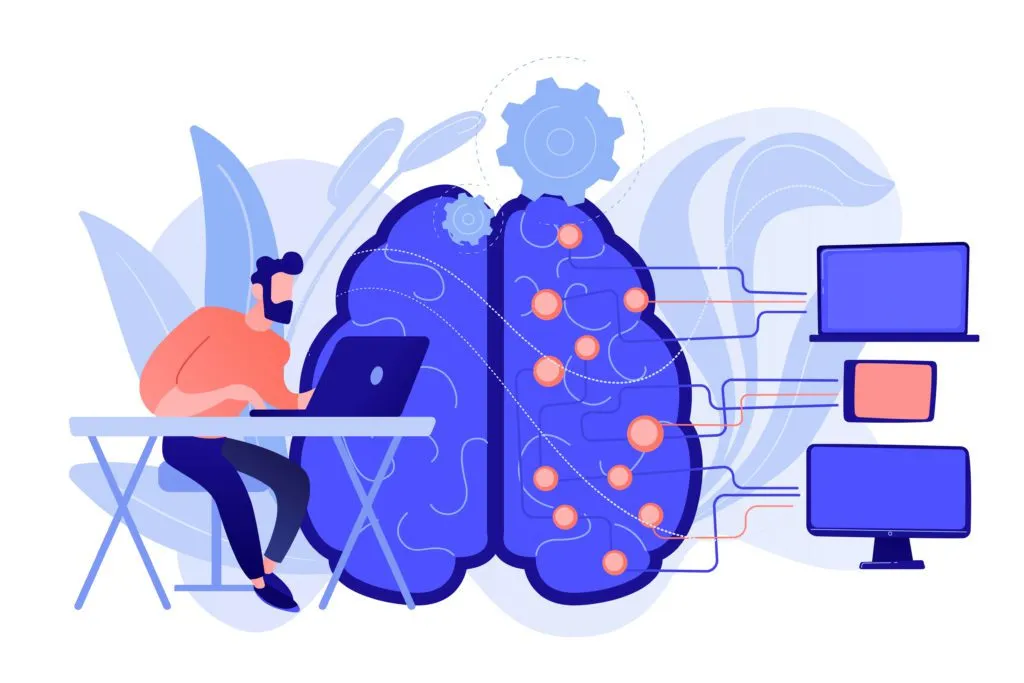
Augmented Intelligence helps drive businesses by working alongside Artificial Intelligence. It enables organizations to generate faster results and improve decision-making. For higher value creation, AI systems must perform effectively in collaboration with human intelligence.
Here are the top 8 ways different industries use Augmented Intelligence:
- Retail Businesses
- Businesses use this technology to create immersive shopping environments, ensuring a better virtual shopping experience. Customers can enjoy personalized experiences through AI-powered tools.
- AI can create 3D virtual stores that replicate traditional in-store shopping.
- A common example of augmented intelligence in retail is virtual assistants. They support customers but do not replace human decision-making.
- They provide required data on demand. Other technologies such as the Internet of Things, big data, and cloud storage enable efficient data collection, storage, and analysis.
- AI helps businesses improve conversions and shopper engagement. It enables online retailers to understand customer behavior and supports machine cognition.
- Industrial and Field Services
- Many real-time AI solution providers streamline field operations using tools such as mobile apps and smart glasses, greatly assisting field engineers.
- These tools provide real-time situational awareness and enhance the engineer’s field of view, improving safety and reducing confusion.
- AI enables faster learning and adaptation, improving business intelligence and transforming how engineers operate in the field.
- Modelling & Design
- Augmented intelligence provides end-to-end support for designers, allowing them to visualize products on tablets without creating physical prototypes.
- It enables comparison between existing and new product designs and supports early-stage development.
- These tools enhance decision-making and cognitive augmentation, helping create effective designs and models.
- When used effectively, AI-driven tools provide a strong competitive advantage.
- Training Services
- AI has gained momentum in education and training by supporting deep learning and enhancing traditional lab-based learning environments.
- AI-based training systems improve continuously without requiring additional programming and provide immersive, multi-sensory experiences.
- Deep learning in AI mimics human brain functions, enabling more effective and in-depth training.
- Maintenance Services
- AI applications on tablets or smartphones provide users with maintenance and repair information.
- They can generate 3D visuals and step-by-step instructional videos, improving repair efficiency.
- By combining human expertise with AI insights, organizations gain better operational access and efficiency.
- Financial Sector
- Augmented intelligence supports financial planners in delivering personalized services aligned with client goals and risk appetite.
- Big data enables predictive analytics in areas such as customer preferences, marketing, and data mining.
- AI tools help financial data scientists analyze large datasets and identify meaningful patterns.
- Healthcare Sector
- AI improves patient care, reduces medical errors, and accelerates administrative processes such as claims and billing.
- Healthcare professionals gain better insights into trends, risks, and operational factors, improving service quality and decision-making.
- Hospitality Sector
- AI helps manage customer complaints, feedback, and interactions, improving service flow and operational efficiency.
- Unlike earlier autonomous systems, augmented intelligence now supports humans by providing actionable data.
- It enhances efficiency, knowledge, and automation while retaining human judgment.
- Organizations can manage risks, augment expertise, and improve operations through AI-supported decision automation.
Applications of Augmented Intelligence
There are many reasons behind AI’s popularity. It transforms decision-making. Enterprises develop partnerships with this system. It is a combination of industry and technology.
Many businesses support industry-controlled AI. There are endless opportunities with the tools. They associate businesses with unique needs.
This helps many brands. It also helps in augmented intelligence. The best benefit is a smoother operation.
Synopsis
The only limitation of this technology is that it is unpopular. Many sectors don’t use technology with processes. This stops them from realizing its vast benefits.
Many users want customer experience and employee experience. AI-powered analytics help these. Thus, companies should realize their full potential.